I found an old Adam At Last post the other day that made me literally laugh out loud, which is one of my favorite things about going through this archive because twenty-year-old me had a lot of opinions and apparently very little fear about putting them on the internet. In November of 2000 I was sitting around watching television and, for reasons that are now completely lost to history, had the thought that “dressy scarfs aren’t good for guys.” Not scarves that kept you warm, mind you. Those were fine because they served a purpose. I specifically objected to decorative scarves, which I had apparently decided were a bridge too far for the male wardrobe. A few hours later I saw a bunch of Gap commercials in which men were wearing colorful striped scarves and took this as proof that my opinion was authentic. I had independently arrived at the opposite conclusion from the Gap. I had not merely been told by the punk scene that the Gap was uncool. No, sir. I had evidence. I wrote, with what I now recognize as a combination of earnestness and self-aware stupidity, “wow. i was one step ahead. i am truly punk now.” Then I ended the whole thing with, “it’s funny what you find validation in.” Twenty-five years later I read that and immediately pictured the decorative scarves hanging in my closet. Not one. Scarves. Plural. I laughed hard enough that the whole post instantly became something I wanted to write about again, because my logic holds up. Except future me doesn’t agree.
“dressy scarfs aren’t good for guys.” … “wow. i was one step ahead. i am truly punk now.” … “it’s funny what you find validation in.”
Adam At Last, November 2000
I was trying really hard to be punk at twenty. I wore high-top Chucks, usually Levi’s 501s or brown Dickies, a black T-shirt, definitely a studded belt, and my hair existed somewhere on a repeating cycle between shaved completely off and whatever happened when I let it grow until I got tired of it and shaved it again. I liked MxPx a lot and went to a bunch of their shows with Josh. I liked Ninety Pound Wuss and a lot of the Christian punk bands. But the truth is I was never really a hardcore punk kid. I didn’t know that many of the “real” punk bands. I was much more of an indie kid with a slight punk edge who loved the idea of being punk. What I wanted more than anything was a way out of being a boring mainstream Christian kid. I had grown up in churches that I was tired of, even if I didn’t yet have the vocabulary to explain why. The music sucked. The lighting was horrible. The culture felt stiff and bland and like something I was supposed to fit into even though I had never really felt like I fit anywhere. Living on the Oregon coast had already cracked that open for me because I tried a few small churches that felt different, and then my friend Laura Bisbee took me to Imago Dei in Portland. I had heard about it. She told me I would like it. She was right. I walked into this old church building and people were dressed cool and comfortable, nobody was wearing a suit, the music actually sounded like music I would choose to listen to, the room itself felt good, and I loved the way Rick McKinley taught. It was the first time I had seen Christianity and the indie world I wanted to inhabit sitting naturally in the same room together. I still didn’t feel like I belonged, exactly. I wouldn’t really understand until middle age, The Break, and a frankly heroic amount of therapy that I had spent most of my life feeling like the outcast even when I was surrounded by people who loved me. But Imago Dei was a doorstep. When I decided I was going to move to Seattle the following year and started researching churches, Imago Dei led me to Mars Hill. Mars Hill led me to Heidi. Heidi and I eventually got married and then, with a degree of enthusiasm and repetition that does not need much further explanation, we started having babies.

Rory was number three. Heidi told me they were coming by giving me a positive pregnancy test as a Christmas present, and I was so fucking happy. Evelyn had been born April 27, 2005. Theo came November 25, 2006. So by Christmas 2007 we already had two very small children running around our house in Mountlake Terrace, my sister was living with us, we had our dog Oliver, and I was working at Mars Hill. Rory’s pregnancy was actually the only one of the four where I was employed for the entire pregnancy. I was unemployed during Evelyn’s and Theo’s pregnancies, and by the time Finn came along I was just starting Bootstrapper Studios, which is a different flavor of “employed” when you are the one inventing the company as you go. So there was a version of stability around Rory’s arrival that the other pregnancies didn’t have. We had a house. I had a job. We had community. We had two little kids who were already excited about the idea of another baby. And I had absolutely no memory, until we went digging through Gmail for this post, of how quickly the pregnancy became terrifying.
This is one of those places where the archive and my memory disagree, and I am not going to pretend my memory wins just because it lives in my head. I remembered the pregnancy as getting scary later. I vaguely remembered bed rest, but I thought that happened much further along. The emails say otherwise. On January 4, 2008, barely after Christmas, I emailed Dwayne, Dustin, and Ryan and told them Heidi had been having complications. We had gone in for an ultrasound and they couldn’t see the baby’s heartbeat when they thought they should be able to. The doctor called after we left and said there was hemorrhaging and it looked like we might be losing the baby. I asked our friends to pray that we could rest in God’s will while we waited for more bloodwork. Three days later I sent an update saying Heidi’s HCG levels had doubled “just like good little HCG levels are supposed to,” which meant we weren’t losing the baby after all; Rory was apparently just too small or too early to see properly. Heidi still needed to take it extremely easy, and not long after that doctors ordered her onto bed rest for at least three weeks. I sent out a giant email asking friends to cover the house from 8:30 to 5:30 while I was at work, keep Heidi company, play with Evelyn and Theo, and do some housework. Reading that in 2026 made me laugh because my first thought was, Why the hell was I asking other people to clean my house? Couldn’t I clean? In my defense, the email was specifically about the hours I was at work, and the larger truth is that we had a really good community then. Marin Kaetzel, Joy Forehand, Kari Edmondson, Kristin Oakerson, Jessica Abrams, Rose Johnson, Heidi Myers, and plenty of people I’m forgetting sprang into action. We had meals. People came over. Heidi wasn’t left alone trying to stay horizontal while two toddlers treated the house like toddlers do. Even then I still felt like the outcast in the group, because that feeling followed me everywhere, but it was really nice to have a community where I could be myself and where, when we said we needed help, people actually came.
By April the paper trail gets wonderfully blunt. A prayer update from our community group after an ultrasound simply says: “It’s a healthy baby girl.” My first thought, or at least one of the first, was Abu el Banat — father of daughters — because of The West Wing. I thought God had a sense of humor. I genuinely did not know how to raise girls. I was so lost. But I was also so happy. I loved the idea that the three kids would be this little trio, all so close in age, growing up together, and I was already thinking about how much fun I was going to have with them when they got older. That future did not unfold in the tidy way twenty-seven-year-old me imagined, and there is a lot of family trauma between there and here that belongs to other stories, not this one. But the funny thing is that the future I imagined may be taking shape now anyway, eighteen years later, as these three of my kids move into young adulthood together. Rory turned eighteen just a few days ago. The “little trio” is not little anymore, Finn exists because apparently we did not stop at three, and I can say with absolute confidence that one thing younger me got right was that I would have a ridiculous amount of fun with my kids as they got older. All four of them.
The names, by the way, were never planned this far in advance. We always had boy names ready. The first boy was going to be Otto. I think the next one was Jameson. Every time we found out we were having another girl we had to scramble. We settled on Jane because Uncle Dennis had told us so many incredible stories about his mother, Jane. I can’t remember the actual stories anymore, which is maddening, but the feeling survived: she was an amazing woman. I had met her myself on the trip to St. Paul with Aunt Donna to get a desk, so the name belonged to a real person in my memory, not just family mythology. We chose Olivine because we liked the way it sounded. Then someone made a typo on the birth certificate, so Rory’s legal middle name became Olivia. They still go by Olivine. This is apparently how family history works: reverence, memory, bureaucracy, and clerical error all contributing equally.
By the time labor actually came around we were on kid number three, which you might think would mean we had this shit down. We did not. Nothing ever happened the same way twice. We did at least know what contractions getting closer together meant, and because of all the complications during the pregnancy we got to Evergreen in Kirkland with plenty of time. This is also where my own memory becomes almost useless. The four births have mushed together in my head over the years. Hospital rooms, nurses, contractions, waiting, trying to be useful while not being the person actually doing the impossible physical work — a lot of that has become one generalized “birth” memory. What survived are the anomalies. Rory’s anomalies are Jack in the Box and the NICU. Thankfully, 2008 me was already incapable of experiencing anything without documenting the hell out of it, so the tweets can carry the parts forty-five-year-old me lost.
“Woo! At the hospital, looks like @janewygle is going to join us very soon!”
Then: “heidi just said that she’s starting to remember what the pain feels like. And smiled.”
Then I complained that the room had no cell reception but good Wi-Fi, because of course I did. Then I mentioned being hungry. Heidi and the nurse told me I should go get food. I hesitated. They both told me, essentially, GO. So I went through the Jack in the Box drive-through, and that part I remember. It took forever. It felt like an eternity. I remember the bizarre feeling of sitting in that line thinking, I cannot believe I am at Jack in the Box while my wife is in labor. Apparently someone on Twitter questioned this decision because I immediately defended myself:
“I mentioned that I was hungry, both Heidi & the nurse said I should go get food. I hesitated and both said ‘GO!’ but nicely :)”
By the time I got back I tweeted that the contractions were progressing very fast, then took a picture of my cozy purple chair, then posted that Heidi’s contractions were “breaking the charts.” My sister was there keeping her company. Damien Jurado was playing, which I noted had happened for all three births. Then, at 2:26 in the morning, the archive says Rory arrived: nine pounds, beautiful, and headed almost immediately to the NICU because they were having trouble breathing regularly.
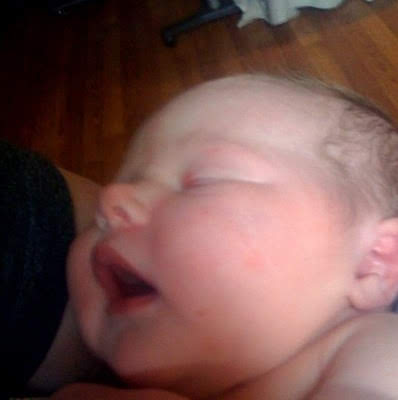
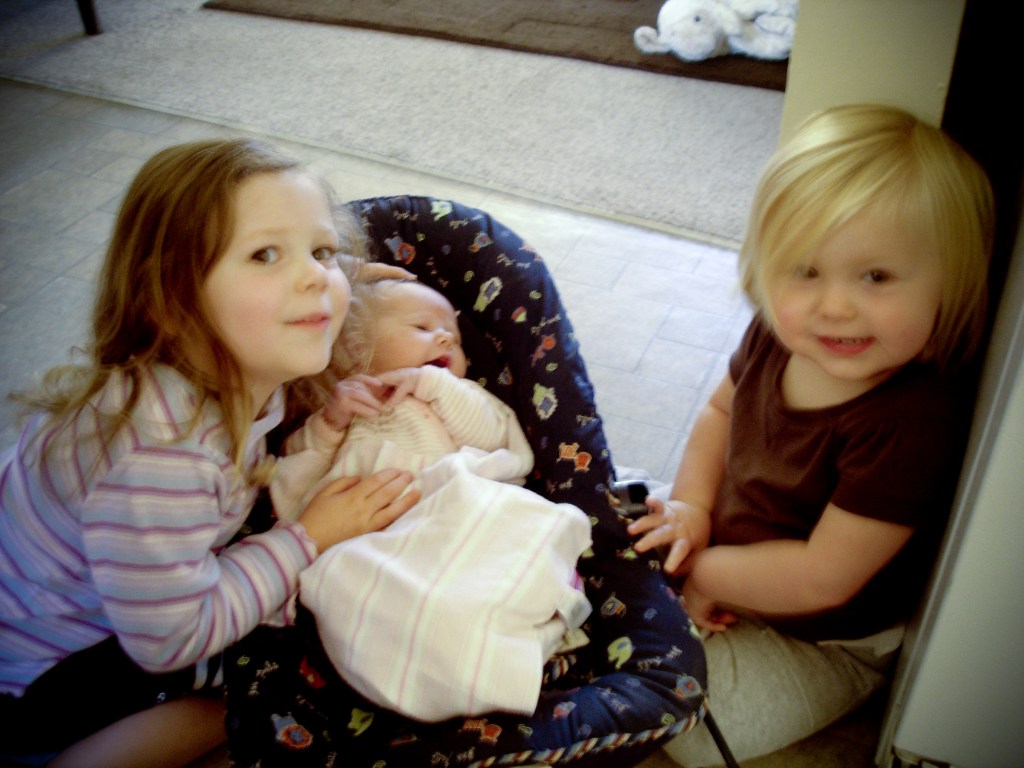
NICU is a word that sounds terrifying when I type it now, but that is not how I remember feeling then. I think they just couldn’t get Rory’s breathing to regulate and the doctors told us it was pretty normal, that they wanted to give them a little help and watch them for a while. I wasn’t scared. I remember going upstairs with Rory and staying with them. I know I wasn’t holding them, so they were probably in one of those clear bassinets, and of course I was talking to them because I had just met my kid and had a lot to tell them. I have no idea what I said. I’m not going to invent it. The words are gone. What remains is the knowledge that I talked. The archive fills in the timing again: not long after the birth I tweeted “Jane’s first outing. Only 30 minutes old.” Later that morning came the update, “Oh, @janewygle is good and out of NICU. She was just having some breathing problems, but she figured it out.” What I remember is coming back downstairs and Heidi finally getting to hold Rory again. We had gone upstairs so quickly after the birth that Heidi barely got any time with the baby before we left, and I’m pretty sure she was very happy and basically begging for her baby back when we returned. A little later Evelyn and Theo came to meet their new sibling, and they were thrilled. They had been waiting for Rory. There is a photo of the two of them gathered around the baby that looks exactly like the future I was imagining when we got that “healthy baby girl” ultrasound: finally, you’re here.
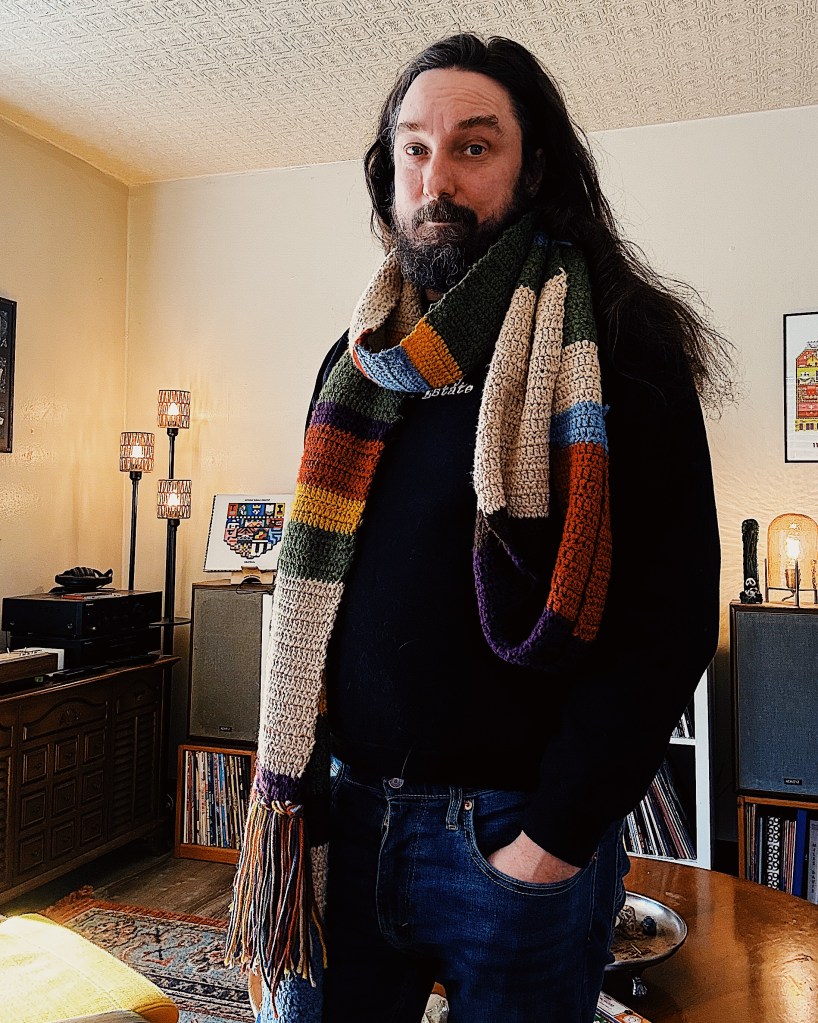
Seventeen years later, at Christmas, that baby gave me a scarf. Not just a scarf. A fourteen-and-a-half-foot Doctor Who scarf that Rory crocheted themselves. I was gleeful. I don’t have a better word for it. I was so fucking happy. I honestly think it is the coolest thing they could possibly have given me, and I cannot begin to describe how much joy I felt when I saw it. Which is why discovering the old “dressy scarfs aren’t good for guys” post months later was so funny. The twenty-year-old who had apparently established a personal moral boundary around decorative neckwear had no idea that the forty-five-year-old version of himself would already have multiple decorative scarves hanging in the closet, much less that one of his most treasured possessions would be a monstrously long, rainbow-striped scarf based on a British science-fiction show. And there had been a lot of scarves in between. For years I had dozens and dozens of Sounders, Reign, and S2 scarves. Most of those were ceremonial more than anything. I wore them to games, usually the same favorite one over and over, while the rest were basically a collection. They were decorative. They didn’t carry a lot of meaning individually. Most of them disappeared when I moved out of the house and into this apartment. I miss them sometimes, although I also look around this small apartment and think, where the fuck would I have put all of those? Rory’s scarf is in a completely different category. The value is not the yarn. It is the love and time and dedication that went into making it. I can see hours of Rory’s life in it. It is one of those rare objects where “I fucking love it” somehow feels inadequate.
And this is where the stupid Gap post turns into something I don’t think twenty-year-old me could have understood yet. He wanted to be punk because he wanted out. He wanted out of his parents’ house. He wanted out of the boring mainstream Christian-kid identity. He wanted music that didn’t suck and churches with lighting that didn’t make him want to crawl out of his skin. He wanted to go to shows and meet women and have long conversations with friends and climb things for no reason and be loud and rambunctious and experience life. He was surrounded by people constantly. Read Adam At Last and that guy is always doing something with somebody. Shows. Friends. Women. Road trips. Conversations. Plans. And he was lonely as hell. He was alone in a sea of friends. He kept looking at groups and scenes and relationships and wondering if maybe this was finally the place where the rules would make sense and he would know he belonged. Even “I am truly punk now” is funny because underneath it is this little pulse of relief: I had the right opinion on my own. I didn’t copy it. Maybe this means I really am one of these people. Forty-five-year-old me is almost the photographic negative of that guy. I am alone in a sea of nobody a lot of the time, and I’m not lonely. I want companionship. I want love. I absolutely want another person in my life. But I don’t need another person, a church, a scene, a friend group, or a Gap commercial to tell me what the hell I am anymore. Therapy did a lot of the work that punk was trying to do for me at twenty. Somewhere along the way I realized I missed being loud and rambunctious. I wanted that part of myself back. I also realized I was probably too old to be climbing random pillars just for the hell of it, so I started dressing loud and rambunctious instead. I want to be colorful. I want to be fun. I don’t want to blend into the scene anymore; I want to stand out from it. I love when somebody compliments my scarf or my coat or my glasses because it makes me genuinely happy that somebody else gets what I’m doing. I just don’t give a fuck if they don’t like it. That is the difference. Approval is delightful now. It is not evidence.
Which, hilariously, might mean I finally figured out how to be truly punk. If I wear Rory’s scarf out in public, what it says is basically: I don’t give a fuck what you think, imma wear the hell out of this monstrously nerdy scarf. And if you are a Doctor Who fan, it says something else too: Hi. I’m one of you. That kind of belonging feels completely different. I am not asking permission to join first. I am being myself loudly enough that the people who recognize it can wave back. I was thinking about what twenty-year-old me would make of that photo of forty-five-year-old me wrapped in fourteen and a half feet of scarf, and it turned into a much more existential question than I expected because, despite everything that has changed, I think he would recognize the guy. I’m wearing a black Sunny Day Real Estate sweatshirt. I still wear Levi’s. There is still a pair of Chucks in my closet. Music still matters to me. Handmade things still mean more than mass-produced bullshit. I don’t think there is a psychic link in this hypothetical, so twenty-year-old Adam doesn’t get to know the therapy story or The Break or the divorce or who Rory becomes or why the older guy looks so goddamn happy wearing that thing. He just gets the visual evidence. And I honestly think his verdict would be: yeah, okay, that scarf serves a purpose. It isn’t just some designer scarf. Also, somebody made it by hand. Most importantly, it did not come from the Gap.
Rory, if you read this someday, the scarf means the world to me. I hope I can hold onto it forever. I honestly think it is the best thing you could ever have given me. Someday, if you have children, I want to be able to give it back to them. I want them to know that their parent made this ridiculous fourteen-and-a-half-foot scarf when they were seventeen and gave it to their papa, and that he wore the hell out of it. That is how important it is to me. Twenty-year-old Adam was worried about what a scarf said about the guy wearing it. Forty-five-year-old Adam finally has an answer: this one says my kid knew me, loved me, spent an absurd amount of time making something specifically for me, and trusted me to be exactly weird enough to treasure it. My logic holds up. Future me just finally learned what mattered.


Leave a Reply