The random date generator landed on Tuesday, July 17, 2007, which at first looked like one of those dates where the archive was going to hand me a bunch of links and expect me to pretend there was a story in there somewhere. There were tweets about Twittercal and an Engadget post about a Space Invaders clock. There was an iPhone story about Duke University. I was talking to people about music search sites and Mac stuff and Mars Hill tech problems. If I had stopped there, July 17 would have been one of those perfectly ordinary little internet days where twenty-six-year-old me was apparently online all the time and had opinions about everything with a URL. But the whole point of Random Date Archeology is that you don’t stop when the first layer looks boring, so I started pulling backward, and July 17 turned out to be the day after one of those weekends that my brain has filed in Ye Ol’ Hall of Remembering under the category of yes, that happened, probably, except almost every detail I thought I remembered was slightly off.
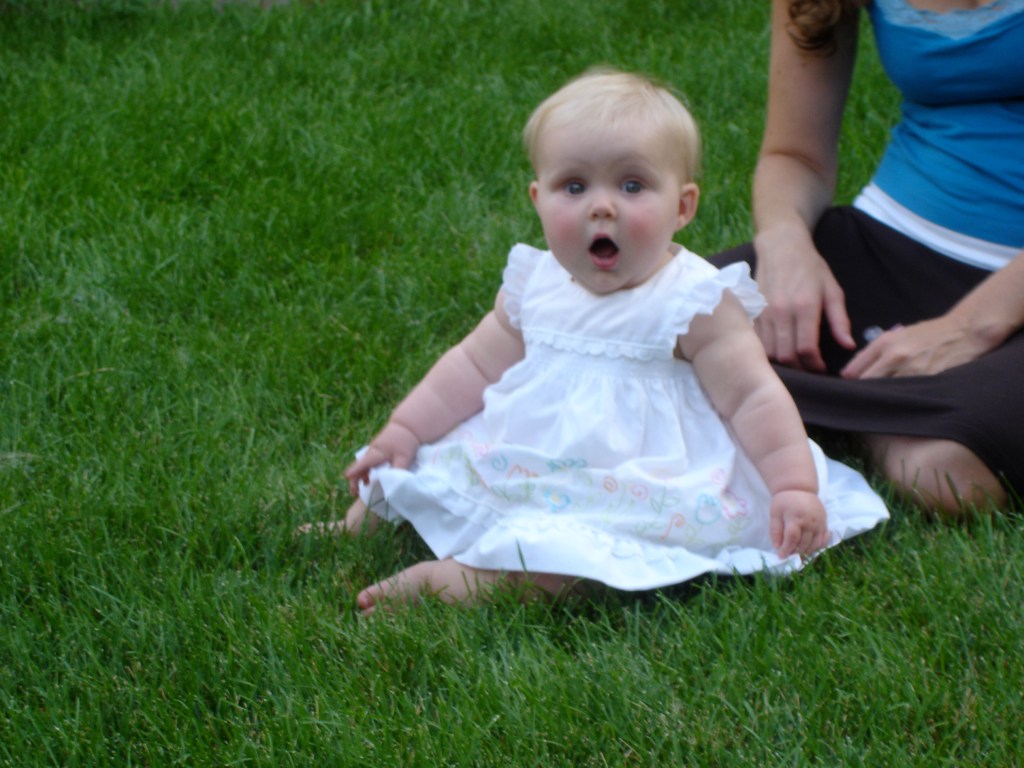
The weekend itself was normal. That matters. We had gone out to Richland to stay with Aunt Donna and Uncle Dennis, which was not some rare family expedition. I spent a lot of weekends at their house growing up, and later my kids did too. It was part of the family geography, one of those places that existed in the background of life without needing to announce itself as important. Donna is my dad’s sister, and she has always been one of those people who feels less like an aunt and more like an extra parent. By 2007 I was married to Heidi, Evelyn was two, Theo was about seven months old, and my sister Steph was living with us, renting the spare bedroom. My parents were there in Richland that weekend too. We swam in the pool, sat around, hung out, did the completely ordinary things families do when they have repeated the same visit enough times that nobody needs an itinerary. I know the Theo photo I’m using with this post was taken in Donna’s backyard on that trip. I can look at the rest of the set and see Donna, Dennis, my mom, Heidi, Evelyn. The photograph is useful precisely because nothing dramatic is happening in it. Theo is just a baby on the grass. The disaster has not started yet.
We left the Tri-Cities on Sunday, July 15, headed back toward Seattle, and somewhere before Yakima, near Toppenish, the car blew up, which is the phrase I used at the time because apparently subtle mechanical language was not my specialty. My Twitter archive says, “We’re stuck on the side of the road near yakima. Our car blew up.” In Google Chat I was more specific: a hose had exploded. “It’s the big radiator tube,” I told Dustin DeKoekkoek. The temperature was supposed to get into the mid-90s, Heidi and the kids were with me, Steph was with us, and my immediate concern was not the car. It was getting everybody off the freeway. “I’m just thinking of getting my wife and kids off the freeway then we’ll figure out getting home.” That line feels familiar to me even though I do not actually remember saying it. The event itself survived in my memory. The details did not.
This is where the archaeology got weird. My working memory of the day had been that we got the car towed to a mechanic, then somehow got connected with friends of Steph’s who lived in Yakima. They picked us up, took us back to their house so the kids would not have to sit around at the shop, and we spent a few awkward hours in a generic suburban neighborhood with people I barely knew while the car got fixed. That is a perfectly coherent memory. It has a beginning, middle, and end. It is also not quite what happened. Steph confirmed that she was there, which is funny because I had managed to remember her friends while completely removing my sister from the car. She also confirmed that they were friends of hers from Ecola. I had remembered that connection correctly. I had just misplaced the person who made the connection possible.
Then the emails made the scene move again. We did call for a tow truck. We were waiting for the tow truck, Steph’s friends, and my parents. Dustin was spreading a prayer request through our community group, Pownce, Twitter, the Mars Hill members site, and probably every other communication platform that existed in 2007. But somewhere in the middle of all that, I fixed the car myself. I had completely forgotten this. Not “forgotten what size wrench I used” forgotten. I had forgotten the entire fact that I was the guy who got under the hood. In an email later that afternoon I wrote that we were off the freeway and at the friends’ house waiting for the engine to cool. Then: “I replaced the radiator hose, which I thought was the problem.” I had gone to Schuck’s, replaced the hose, put fluid in the car, drove four blocks, watched the engine start overheating again, and then decided to keep going another five and a half miles to the house where Heidi and the kids were waiting. By then the car would not start at all.
When I first read that back, my reaction was basically, Wait, I fixed it? And then another door in my memory opened and the answer became, Of course I fixed it. There was a period of my life when I fixed things because that was simply what you did. I had just come out of a short life as an electrician. I had ridden mopeds and that meant I had fixed my own moped. Money was tight, so paying somebody else was not always an option, but there was also something in me then that was much more willing to dig in and get dirty. I was not especially scared of machinery. I would open the thing up, look at it, ask somebody what they thought, make a run to the parts store, and see if I could make it work. That version of me feels strangely distant now. Present-day me would much rather hand someone money and say, “Please make the bad noise stop.” But 26 year old me was standing in Yakima on a hot Sunday afternoon replacing a radiator hose because there was a wife, two babies, a sister, a mountain pass, and no obvious better plan. I need to be more like 26 year old me.
The hose did not solve the whole problem. The car kept overheating. Dustin talked to his dad and relayed the possibilities: maybe a water pump, maybe a head gasket, check the oil for white foam, all the sort of advice that becomes extremely comforting when you are sitting in a stranger’s driveway hoping your car will agree to drive across the Cascades. I let the engine cool. I filled the radiator with water. I let it cool some more. Eventually it started. I drove it around for three-plus miles, filled the gas tank, drove back to the house, let it cool again, filled the radiator again, and then decided to try for home. This is the part that lines up with my present memory most strongly. We fixed it enough to make it move, and then we drove ourselves home.
The chat archive catches the drive in little status pings. Dwayne Forehand asks how it is going. “Driving,” I answer. “So far.” Then, because I am apparently attempting to conduct tech support on myself while operating a questionable vehicle, “Gotta drive.” A little later I check in with Dustin from Bellevue. The car is still running. “No problems.” “It seems to be.” We are exhausted. I say I am going to have to buy Heidi a “non exploding car.” About thirteen minutes later I post, “8 hours after leaving the tri-cities we’re in Seattle.” That sentence is probably the cleanest surviving end to the whole thing. We made it. The car made it. Whatever exactly was wrong with it could become Monday’s problem.
There is one piece of the story that remains fuzzy even after all this excavation. In the first roadside chat I said we were waiting for “a tow truck, my sisters friends and my parents.” My parents had been in Richland with us, but they would normally have been headed south toward Portland, not west toward Seattle, so if they actually drove all the way toward Yakima to get us that would have been a significant detour. I do not remember them arriving. It does not ring a bell at all, and it feels like the kind of thing that would have stood out. Maybe they started toward us and turned around once the car stabilized. Maybe they came part of the way. Maybe they showed up and my brain threw that entire scene into the same dumpster where it put Steph and the radiator hose. I do not know. The sentence in the chat proves I expected them to be part of the rescue attempt. It does not prove what happened next. That blank gets to stay blank.
What I do remember is the house. Not the people very well, not their names, not the layout, not a specific conversation. Just a generic suburban neighborhood in Yakima and the mild awkwardness of sitting around in somebody else’s home while waiting for an uncertain amount of time. I did not know Yakima. I was disoriented. Steph knew these people from Ecola, but I did not. We had little kids with us and nobody knew whether the car was going to be ready in twenty minutes or four hours or whether we were about to start negotiating a completely different way home. So we sat around and chit-chatted. That was what my brain kept. It kept the emotional geometry of the room and deleted most of the cast list.
And then, apparently, on Sunday night I posted “I hate cars.” This may be the most accurate historical document in the archive.
The funny thing about the random date itself is that July 17 was not the breakdown day. It was Tuesday. The car drama had ended Sunday night, Monday had come and gone, and by Tuesday I was already back inside the machinery of Mars Hill as if nothing had happened. My calendar that day is almost comically specific: 11:00 to 11:15, Tech Staff Scrum in Wedgwood Room 102. Noon to 1:00, Wedgwood Staff Summer Grill. 1:00 to 5:00, “Fix Pastor Tim Quiring’s MPB” in the IT Den. Then Community Group from 7:00 to 10:30. I was still technically a volunteer at this point, which is where the whole thing becomes very Seinfeld. I was Kramer at Brandt-Leland, except everybody actually wanted me there. I would show up around ten in the morning and work a full day. People assumed I was staff because functionally I was staff. I had a desk, an email address, support tickets, pastors handing me broken laptops, staff meetings, staff lunches. The paycheck was the missing feature.
The chat logs match the calendar closely enough that I can practically watch the day happen. Around ten I am talking with Sam Barrett and Dwayne about Jason Hickner because that Space Invaders clock he made landed on Engadget. A little before eleven I am talking with Preston McGee about Windows password expiration for pastors and telling him we need a backup solution for Pastor Scott. Around noon I message Jon Krombein the single word “bbq,” which is apparently all the context a 2007 friendship required during the Staff Summer Grill. By three I am talking with Nate Whistler about why FolderShare will not work on Pastor Tim’s machine because the ports are blocked. In other words, the calendar entry saying “Fix Pastor Tim Quiring’s MPB” was not aspirational. I was sitting in the IT Den fixing the thing.
That Tuesday also contains the detail that makes the DIY-car version of me make more sense. Around 3:49 in the afternoon, Heidi calls and asks whether she should take some food back to Costco. I tell Sam, “we’re needing that money.” Then, when he asks what for, I answer: “radiator.” This was not a quaint period where I repaired cars because I had discovered a charming hobby in practical mechanics. We were broke enough that car repairs could push groceries back across the Costco counter. The Sentra had just needed a radiator. Friends had helped cover that bill. Then the other car exploded a hose in Yakima. Sam started trying to figure out whether he could use an under-budget Mars Hill “volunteer appreciation” line to help us and asked whether he could buy us $200 worth of gas cards. I suggested cigarettes and alcohol instead, because apparently I was determined to help him misuse church funds in the funniest possible way. He pointed out that he would get fired. We eventually returned to the gas cards.
That is the part of this whole excavation that I did not expect. I thought I remembered a car breaking down on the way home from Aunt Donna’s. I remembered getting stuck in Yakima. I remembered strangers letting us sit in their house. I remembered the event. What I had lost was the person I was inside it. I had forgotten Steph was even in the car even though she lived with us. I had forgotten I fixed the hose myself. I had replaced myself in the story with a mechanic because that is what present-day me would do. I had compressed a Sunday afternoon of phone calls, prayer requests, parts-store runs, cooling cycles, water, test drives, and a gamble across the mountains into “we got the car fixed somehow.” Ye Ol’ Hall of Remembering kept the exhibit and threw away half the placards.
And then the random date hands me Tuesday, which is somehow the perfect epilogue. Two days after the freeway, I am back at Mars Hill by ten in the morning doing a job I do not technically have yet. I am fixing other people’s machines after spending Sunday fixing my own. I am worrying about grocery money and radiator bills while sitting at a staff grill as a volunteer everybody thinks is staff. I am trading music links with Dustin, talking about Engadget, helping pastors get into Windows, discussing an upcoming camping trip, and going to community group that night. Steph tweets that there are three more days until Harry Potter 7, and clarifies that HP means Harry Potter, not Hewlett-Packard, because she also lived inside this nerd ecosystem and apparently knew her audience. Life has already snapped back into its ordinary shape.
That might be why the memory got fuzzy in the first place. Nothing about the weekend announced that it needed to be preserved carefully. Aunt Donna’s house was normal. Richland was normal. The kids in the backyard were normal. A shitty old car was normal. Mars Hill was normal. Being broke was normal. Fixing things because they needed fixing was normal. The event only becomes interesting now because I can stand twenty years away from it and discover that the younger version of me was doing things I no longer remember being capable of, surrounded by people I managed to edit out of my own memory, inside a life that felt so ordinary at the time that I never thought I would need to explain it to myself later.
So the random date was Tuesday, July 17, 2007. On paper, it was a day of staff meetings, barbecue, broken laptops, community group, tech links, and Harry Potter countdowns. But underneath it was the residue of Sunday: a blown radiator hose, a hot freeway outside Yakima, Steph’s Ecola friends, two little kids, an exhausted drive over the mountains, and twenty-six-year-old me under the hood trying to make the thing work because that was what I did then. I had forgotten that guy for a while. The archive had not.


Leave a Reply