The random date generator gave me Friday, May 19, 2006. My calendar said I was working at Mars Hill Church from 10:00 to 5:00, although apparently I needed to leave at 4:30 for Rob’s house in Ballard. From there, sometime around 5:30, I was heading north with Dwayne Forehand for the Men’s Advance at Warm Beach Christian Camp in Stanwood. My dad was going too.
This initially looked like a straightforward archaeological dig: church retreat, men, cabins, probably some terrible coffee. Find a few surviving artifacts, see what I remembered, write it up, move on.
But I knew the story, and then I found the schedule.
Across the top, in giant military stencil letters, it said MEN’S TRAINING CAMP ’06. The first session on Friday night was titled “Biblical Man; Physical, Spiritual, Reverse Engineering.” Saturday moved through Men and Sex, separate teaching for married and single men, and “Holiness through Temptation.” Then came Men and Marriage, including a session called “Sins of the Father: What did your father put on you?” Saturday night covered fathers raising sons and daughters. Sunday finished with finances, work, and a “Final Challenge.”
This was not merely a retreat for men. We were apparently assembling one from parts.
The preparation email was equally committed to the theme. We needed sports gear, swimming trunks, sleeping bags, and whatever else was required to survive two nights at a Christian camp forty-five minutes north of Seattle. Alcohol was forbidden, legal smoking was allowed, and guns and fireworks were prohibited, although the writer could not resist adding that guns would be provided—“just kidding-sorta.” The packing instructions told us to “pack like dudes.”
Masculinity could be reverse engineered, but luggage remained instinctive.
I remember surprisingly little about that particular weekend. Warm Beach looked and felt like a generic church camp, and the cabins in my memory could be almost any church-camp cabins in America. The only oddly personal detail is that my ex-girlfriend Amy had worked there, so I was walking around a location that already belonged to an earlier part of my life.
What I remember much more clearly is that this was not our first attempt at building a Biblical Man.
The beta test
The earlier retreat in my memory happened in 2004 at Sunset Lake Camp, outside Wilkeson. I have not found a surviving booking record identifying Sunset Lake, so the location comes from my present-day memory rather than contemporary documentation. I looked at photographs of the camp during this dig and recognized it, including the wooded drive into the foothills. I remember arriving in Luke’s new Prius, which received a more adventurous introduction to mountain roads than Toyota probably intended.
It was a two-night event, and two nighttime scenes remain. The first night, everyone hung around the circle of cabins drinking and smoking. On the second, everyone gathered near the stage around a bonfire. The following morning there were beer cans everywhere—inside, outside, all over the place.
My memory is that Mars Hill made enough of a mess that the camp would not have us back. That would explain why the retreat moved the following year. The ban is something I remember being told, not a fact I could ever consider establishing.
The archive does supply one suggestive little wink. The announcement for the 2005 Men’s Advance advertised a “New location, new breakout sessions—same ever-important theme!” The documented new location was Warm Beach. That does not prove the story about Sunset Lake, but it is at least consistent with my memory that we had worn out our welcome somewhere else.
I also do not remember exactly who was drinking and who was not. I have no specific memory of Mark Driscoll standing around the bonfire with a beer, and I am not going to place one in his hand twenty-two years later because it would make the story funnier. What I remember is that the drinking and smoking were not a secret rebellion by three guys hiding behind a cabin. They were simply part of the culture.
Mars Hill was young, full of young men, and deeply invested in being a church for people who thought church was embarrassing. We drank, smoked, swore, talked about fighting, and congratulated ourselves for being considerably cooler than the evangelical men’s ministries we had grown up around. We knew we were cooler because we had cigarettes.
There was also a lot of talk about masturbation. There was always a lot of talk about masturbation.
The amount of time Mars Hill men spent worrying about what other Mars Hill men were doing with their penises when nobody else was in the room was fucking comical. This does not mean the men confessing vulnerable things were ridiculous. Many of us were carrying real shame and anxiety, and I was completely sincere about mine. The ridiculous part was the system we built around it: an elaborate male bureaucracy dedicated to monitoring whether other men were jerking off.
I know sexual purity was already part of the first Men’s Advance because twenty-six-year-old me wrote about it in 2006. I had invited my dad partly because I knew there would be a session on pornography and hoped it might create an opportunity for us to talk about sex and porn. We did talk afterward, somewhat, although it did not become the transformational father-son breakthrough I had imagined.
That is not a memory I invented during this dig. It appears in the twenty-four-page “First Step” I wrote for a Mars Hill recovery group two years later.
So the project was there from the beginning. The cigarettes and beer communicated one kind of masculinity—rough, unembarrassed, not your grandmother’s Christianity—while the teaching supplied the internal controls. We could drink around a bonfire, but masturbation required an administrative response.
Jacob, Fight Club, and manning up
On May 15, 2005, twelve days before that year’s Men’s Advance, I left behind one of the most useful artifacts in the whole excavation: a LiveJournal post.
It is a perfect little snapshot of my life. I was ripping CDs onto my computer “so they can be ignored digitally.” Heidi was behind me singing to baby Eve. I was trying to get a moped fender from Curt and planning to head to the Dub for “a mug or two.” Simon & Garfunkel was playing, and my mood was “chipper.”
Then I wrote:
Feel like watching Fight Club after listening to the sermon tonight
Immediately afterward, I added:
I also think a lot of guys need to man up (as it were)
The sermon survives. It was Mark preaching “Jacob Wrestles God.” He described Jacob as cowardly and insufficiently masculine, then asked the men whether they had ever been in a real fight—not an argument, a fight. He talked about “dude to dude” fighting, recounted fights from his childhood in SeaTac, and imagined Jesus essentially jumping Jacob in the dark. Jacob needed to be toughened up. He needed fortitude, courage, strength, and masculinity. Boys should wrestle. Men were forged through conflict and hardship. At one point Mark condensed the entire theory into a single sentence:
Women birth males. God makes men.
I heard that sermon and went home thinking, You know what I need right now? Fight Club.
I had somehow watched Fight Club without understanding Fight Club. I watched a movie about alienated men surrendering themselves to a charismatic leader, constructing an increasingly rigid ideology around masculinity, hurting themselves and each other to prove they were alive, and disappearing into an authoritarian movement that promised to restore everything modern life had supposedly taken from them.
Apparently my response was: These guys need a church.
Twelve days later I went to church camp with a bunch of men to learn how to become a man.
Pruning
The next major piece surfaced on September 11, 2005.
That date already carries plenty of obvious historical weight, and it has another private meaning for me: September 11 was the day I left my parents’ house to move to Seattle. Now I know that September 11, 2005, was also the night I took what I understood at the time as my first real step toward recovery from sexual addiction.
Mark’s sermon that night was called “Israel Blesses His Grandsons.” The section that struck me was an extended metaphor about pruning. He described an old apple tree that had grown wild and produced bad fruit until someone cut it back almost to nothing. He called the process “strategic, extreme, painful, traumatizing pruning” and defined pruning as failure, hardship, loss, discipline, pain, struggle, sickness, and suffering.
Pruning hurts like hell.
Near the end, he applied it directly to marriages, parents, and children. If we wanted Christian marriages and Christian families, we had to let God prune us.
Eve had been born on April 27. She was four months and fifteen days old.
In the First Step I wrote the following year, I said the sermon “really struck a chord” and that I knew I had to come clean to Heidi again. I told her on the drive home. When we reached our house, neither of us wanted to go inside and put Eve to bed, so we kept driving. I remembered talking for what seemed like hours, much of it in tears. I decided I would tell my community-group leader and make an appointment with Bent. I did, and both pointed me toward the addiction groups Mars Hill had been advertising.
That night deserves some protection from the jokes surrounding it. I can now mock the obsessive scorekeeping, the sexual panic, and the theological system that taught me to understand myself this way. But the twenty-four-year-old in that car was not laughing. I believed I had a serious sexual problem. I believed my marriage was threatened by it. I believed God was pruning me. I believed confession would hurt like hell and that the pain was evidence I was finally doing the right thing.
Whatever I think now about the framework Mars Hill gave me, the distress inside that framework was real.
The Biblical Man gets a compliance department
By the time we reach the random date—May 19, 2006—the masculinity project had become more formal. The retreat schedule now looked almost like a service manual: physical, spiritual, sex, temptation, marriage, fathers, children, work, and money. My dad was there with me again. I don’t remember much, but what I do remember is that he said he had a good time.
A few months later came FMO: For Men Only.
This was where the work of creating a Biblical Man stopped being a weekend curriculum and developed a quality-control department. In August, Mars Hill held an event called “The Battle for Biblical Purity and Power: For Men Only.” Men were invited to identify addictive behavior, develop alternatives supporting “Biblical purity,” train as accountability partners, and learn to ask one another the right questions. Single men were warned that marriage would not cure compulsive sexual sin. Married men were reminded that it obviously had not.
By September, the archive places me in an FMO group. We made accountability calls and tracked something called a Personal Craziness Index, developed by Patrick Carnes. You selected seven ordinary warning signs that your life was getting out of balance and scored yourself every day, including items like “second looks.” Seeing an attractive woman was presumably an unavoidable system event. Looking again needed to be logged. We had gamified not checking someone out. Civilization apparently depended upon whether my eyes returned to a butt.
Failing to record the score automatically earned the maximum bad score, because if you could not remember to score your craziness, that was apparently proof you were especially crazy.
We also had a First Step Worksheet. It began with the declaration that we were powerless over our sexual behavior and that our lives had become unmanageable. Eventually it asked for thirty examples demonstrating our powerlessness and another thirty showing that life had become unmanageable.
Sixty fucking examples! Step One, it seems, required supporting documentation.
I bought the whole thing hook, line, and sinker. I wrote the enormous First Step. I confessed. I made calls. I tracked myself. I used the language of addiction, powerlessness, acting out, cycles, sobriety, recovery, and purity because I believed it described me.
Then, because merely participating in the Masturbation Industrial Complex was not enough, I volunteered for IT.
FMO needed administrative help, and I was good with computers. I talked to the Mars Hill IT staff and proposed a password-protected site where leaders could manage the ministry. I helped with its email account and created an autoresponder. When it began working, one of the leaders wrote, “very cool with the auto response, Adam. You are a blessing.”
There were discussions about groups in Ballard, Shoreline, and West Seattle; recruiting leaders; managing contacts; handling inquiries; choosing curriculum; defining exit criteria; helping wives; and coordinating future intakes. I was invited into those conversations because I could help make the machinery operate more efficiently.
I was IT support for the Masturbation Industrial Complex.
I built church technology so dudes could more efficiently ask other dudes whether they had looked at boobs twice on a given day of the week.
The artifact explaining why the artifacts are missing
On October 29, 2006, one of the FMO men emailed the group to announce he was deleting MySpace because he kept receiving porn-related invitations. He included instructions so anyone else could delete an account too. The next morning, one of the ministry’s leaders replied:
MySpace is a dangerous place. Getting out is good.
The thread expanded into a discussion of filters, ad blockers, browser extensions, and methods for making the 2006 internet safe for Christian men. Eighteen days later, on November 17, MySpace emailed me a cancellation request for my own account. Another confirmation and a support message arrived on November 18.
I did not leave behind an email saying, I read the FMO thread and therefore deleted MySpace. I cannot prove that direct causal link. But I was immersed in FMO, I had completely accepted its basic framework, and the timing is not exactly subtle.
This would merely be an amusing piece of purity-culture archaeology if it had not created a permanent consequence for the archaeological project itself.
My MySpace archive is gone. The profile, photographs, comments, blog posts, friendships—all of it. I have searched the Wayback Machine in increasingly desperate and creative ways, and there is nothing useful to recover. In 2006 I apparently succeeded at deleting an entire section of my own online history because some damn dude at church said MySpace might show me boobs.
I found the artifact explaining why the artifacts are missing.
The belief system did not merely affect what I did in 2006. It reached forward twenty years and changed what I can know about my own past. We were taught to erase parts of ourselves in the name of purity, and now I am trying to reconstruct those erased parts from whatever scraps survived elsewhere.
But also: boobs. We did all this because boobs.
And then we hit each other
The final turn arrives in 2007, when I was still very much operating inside the system.
On May 23, just over two weeks before the next Men’s Advance, I wrote a long post objecting to the idea of a men’s-only Mars Hill forum. I was not rejecting male accountability or the purity ministries. I explicitly defended men having places to discuss private issues and referred approvingly to Community Groups and “Recovery/Purity/Grace Groups.” My concern was that an online forum might replace real relationships. Men would dump their dirty laundry onto the internet instead of talking to friends, and other men might respond badly—or, in my exact phrasing, “our brothers would handle the situation like dicks.”
I was not saying the system was wrong. I was worried we might do the obsessive male-accountability shit incorrectly.
Then I went to the 2007 Men’s Advance and got into a shirtless fight.
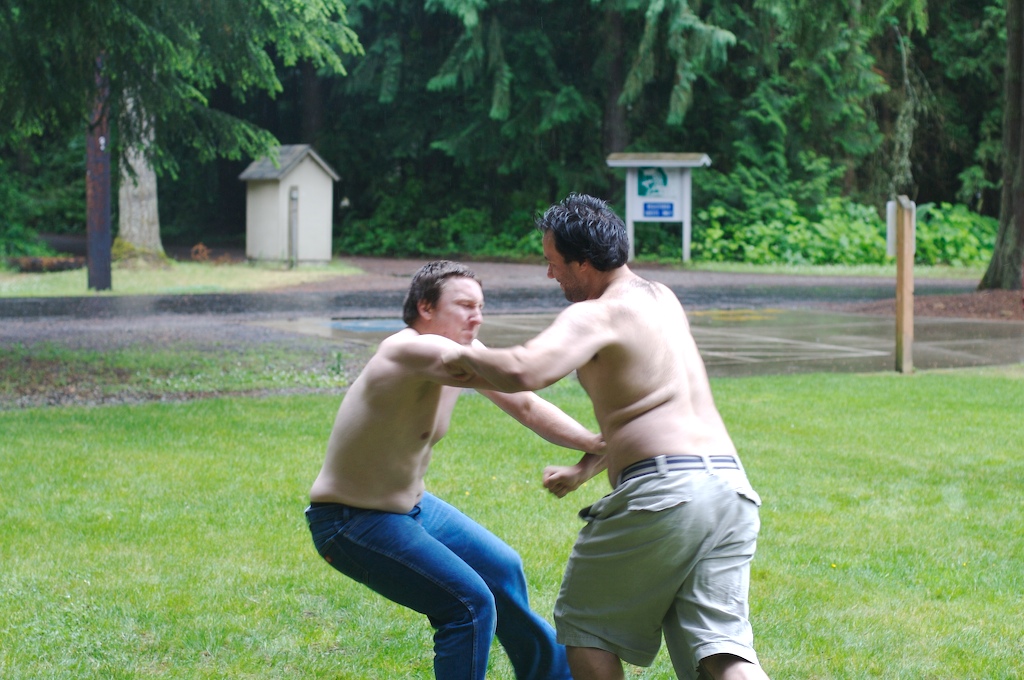
Photo: Drew Pickard.
The surviving messages from afterward confirm the tweaked back and show the guys trading photographs of the fights. I do not need to claim that a particular sermon caused us to fight, or that church leadership ordered anyone to throw me onto the ground. The artifacts can simply sit beside one another.
In this culture, a private act of masturbation required confession, worksheets, daily scoring, accountability calls, and technical infrastructure. Shirtless men fighting each other at church camp required photographs.
Reverse engineering the reverse engineering
The easiest version of this story would be to stand outside it and laugh at all the ridiculous men. That would also be dishonest. I was not standing outside. I was one of them.
I wanted to become the man Mars Hill told me a good man should be. I listened to a sermon about Jacob wrestling God and went home wanting to watch Fight Club. I brought my father to retreats hoping a pornography session would help us discuss sex. I heard a sermon about pruning and confessed to my wife through tears. I carried the second-look sheet, tracked the PCI, wrote the twenty-four-page First Step, deleted MySpace, and volunteered my professional skills to make the purity ministry work better.
That sincerity does not make the system less absurd. It makes the absurdity matter.
The Men’s Advances taught the public version of the man: strong, courageous, combative, sexually disciplined, authoritative in his family, competent at work, responsible with money, and unafraid to drink, smoke, swear, or wrestle another man on the grass. FMO took the same construction project inward, monitoring fantasies, glances, web browsers, confessions, masturbation, and the supposedly dangerous corners of MySpace. The retreat supplied the ideal. The purity ministry inspected the plumbing.
None of this was what I expected to find when the date generator handed me May 19, 2006. I didn’t know I was about to spend a few hours investigating and teaching ChatGPT about a weekend at church camp. One surviving schedule opened into four years of sermons, retreats, blog posts, emails, worksheets, memories, confession, bureaucracy, deleted history, and one remarkably well-photographed back injury.
Mars Hill called the opening session “Reverse Engineering a Biblical Man.”
Twenty years later, Random Date Archaeology reverse-engineered the reverse engineering.
 Wygle Wide Web
Leave a comment