The random number generator landed on Tuesday, February 8, 2005, and this time it appears to have found the first day of a career. My LiveJournal had absolutely nothing to say about it. There was a post in January, then a large empty space, then in April I wandered back onto the internet to mention that I was an electrician now and post a bunch of pictures from St. Patrick’s Day. Gmail was paying more attention. On January 27 I announced, “I got the JOB!!!” A little scheduling confusion followed, but on February 7 my friend Russ asked whether I was starting that day and I answered, “i start tomorrow.” Then I told him I was trying to find more memory for my computer. So there it was: the missing beginning of my electrical career, preserved between ordinary emails about whatever dumb shit we were doing. I was twenty-four, Heidi was pregnant with our first child, and somebody had decided to pay me to help put electricity into buildings. This seemed like an excellent development.
A few months earlier, I had been considerably less sure what anyone was going to pay me to do. I had been fired from Starbucks. When we found out Heidi was pregnant, I was unemployed and trying to figure out what came next, which is a generous way of describing having no fucking idea. I wasn’t choosing from an exciting assortment of careers. A baby was coming, so I took the first job I could get and became a janitor. That was the practical answer available to me. I had a GED, no degree, and a family that was about to get bigger. Naturally, the public version of this situation was a masterpiece of confidence. On December 21, 2004, I addressed a LiveJournal post to “All my High School friends who said I wouldn’t amount to much if I dropped out and got my GED.” The entire body was: “HA! I’m a janitor, eat that, shit-bucket.” Career development, by Adam Wygle.
By late 2004 I was the Night Lead at One Convention Place in downtown Seattle. I had forgotten the building’s name, but the old posts remembered it. I could ride my moped there, which was nice. The hours were not nice. 6pm to 2:30am! Six in the evening until two-thirty in the fucking morning, Sunday night through Friday morning, which did a remarkably thorough job of consuming the parts of the week when I wanted to have a life. The actual job was almost absurdly easy. I was basically an assistant manager, and my memory of a normal night is hanging out with the manager, talking about music, smoking, checking on the other janitors, talking, smoking, getting a hot dog, talking, smoking, cleaning a couple of units together, talking, smoking, and going home. His name has disappeared from my brain, but apparently the smoking schedule is permanently installed. One night another janitor complained that he couldn’t clean a bathroom because an employee on that floor had been “pooping for hours!” That particular workplace incident has also survived twenty-one years. Priorities.
In January they moved me to the T-Mobile assignment in Bellevue as a day porter. They apparently didn’t ask me first, but the important part was that I would be working during the day. In “A Five Gallon Water Jug Full of Change,” I wrote, “That means that my life is back,” then immediately complained about my moped being cold and posted a picture of my electric meter. I had range. The new job gave me my evenings back, but it didn’t give me much to do with the workday. I was alone in a closet most of the time, making the rounds three times a day. I read a lot. I taught myself to solve a Rubik’s Cube, which I can still do. I smoked less, so that was an improvement. They hardly needed me. I had moved from a job where I spent most of the night talking to a guy, to a job where I spent most of the day by myself, waiting for there to be a reason I was there.
Meanwhile, I had been trying to get into SME Inc. of Seattle. Bryan Ver Beek was part of the Abrams’ community group, and the more we talked about electrical work, the more interested I became. The email trail shows me pursuing it through December and January, sending my résumé, following up, trying to find out who had it and how to get someone to look at it. Becoming an electrician hadn’t been my lifelong dream. It was an idea I could suddenly picture: getting out, learning a trade, doing physical work, building things with my hands, having a career. I wanted the better pay and health insurance, especially with a baby coming, but I was also really fucking excited about the work itself. There was even an offer of more money for me to stay on the janitorial side. It was a decent bump over what I had been making, but still below SME, and by then there was no chance I was staying a janitor. I had spent enough time in the closet. I wanted to go do something.
What I remember about my first day is a warehouse somewhere near Alki and some enormous light bulbs. I think we did other things too, but those are the things that stuck: big lamps, being told not to get skin oil on them, and a lift that was much too large for the job. The guy I was working with was frustrated about the lift. It was what they had sent us, so it was what we had, and we made it work. I don’t remember his name. I don’t have a photograph of the warehouse or a surviving work order that can tell me exactly where we were. The emails help pin the date; the warehouse is my memory. But I remember having a really fun day. After months of mostly waiting around for work to happen, I was up on this ridiculous piece of equipment learning how to do something. The career I had been getting excited about was now an actual place I could go, with actual people and actual things to do. That felt pretty good.
Electrical work continued to be a lot more interesting than janitorial work, although I would like to exempt the roofing-shingle factory in Tacoma from any general statement of affection. That place was hot and dirty and gross, and I hated getting sent there. Some assignments were good, some sucked, and a huge amount depended on who I was working with. Donal was one of my favorites. He was a good teacher, and he made me feel like I could do the job. He trusted me with smaller projects without standing over my shoulder the whole time. We clicked. SME had me doing mostly commercial and industrial work, but I also did side jobs with Donal, usually residential rewiring, which gave the work some variety. I wasn’t in love with every minute of being an electrician. I did like being an electrician. When I finally reported the career change on April 2, the review was concise: “I did get a new job, for those who haven’t heard from me. I am now an electrician, it’s pretty rad.” Then it was my sister’s birthday and there were pub pictures to share. Anyway, back to the important stuff.
The other important stuff was Evelyn, who was supposedly going to arrive any minute now for approximately the entire month of April. I was pretty wound up. It was our first baby. Heidi was having contractions. Both of us thought it was happening, and I kept calling out of work to be with her. The contemporary emails preserve some of this: I left around noon on April 11 because it looked like labor, and days later I was still trying to decide whether I should go to work or stay with Heidi. From here, with twenty-one years of hindsight and considerably more experience with babies, I can laugh at it. At the time we were sure. The baby was coming. Get ready. This is it. Except Evelyn had apparently received a different memo and was not participating in our schedule. I had only been at SME a couple of months, and I was already putting their patience through an impressive practical examination.
We were so sure that my mom and dad came up from Portland and stayed with us for a week. They had planned to come when Evelyn was born, and we all figured that had to be any day now. So we hung out, went on long walks, and tried all the things we could think of that were supposed to encourage labor. Nothing worked. There was a whole family assembled for a grand entrance, and the guest of honor refused to leave her room. Eventually my parents had to go home. My dad had used his vacation. We were bummed because we thought they were going to miss the actual birth, and we felt a little guilty, even though none of us knew what the hell was happening. It was frustrating for everybody. We made the best of it, though. A new baby was coming. Even the week of walking around waiting for absolutely nothing to happen was going to be part of her story. We could already laugh about having gotten the entire production ready before the star agreed to appear.
Evelyn finally arrived on April 27, 2005.
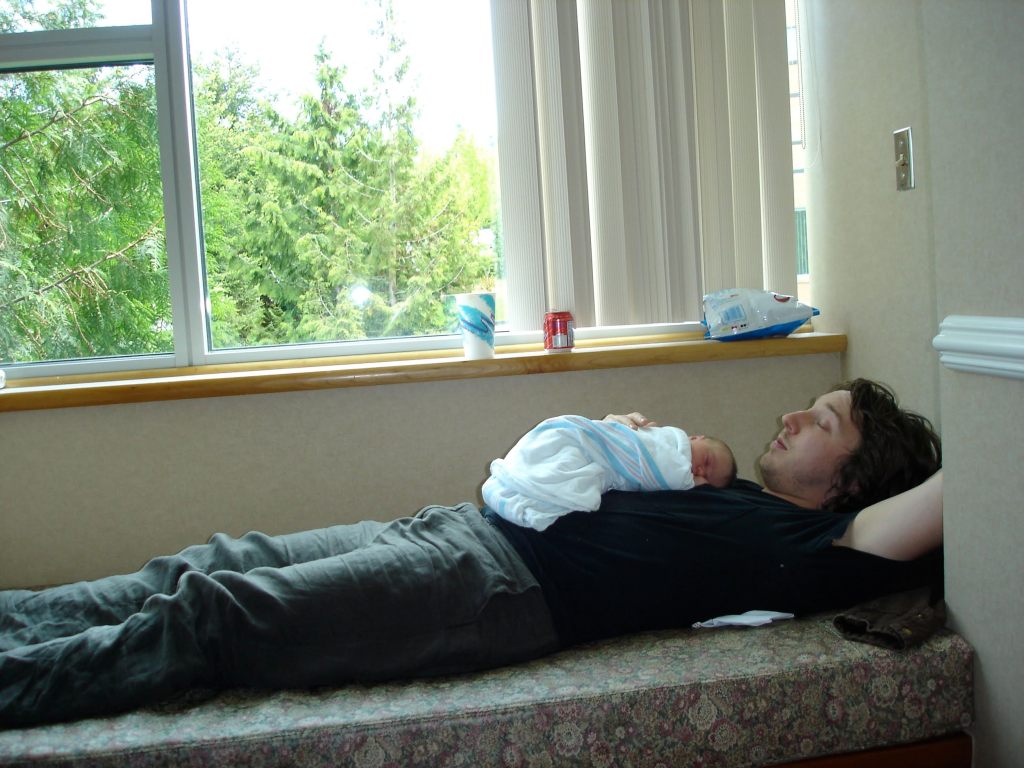
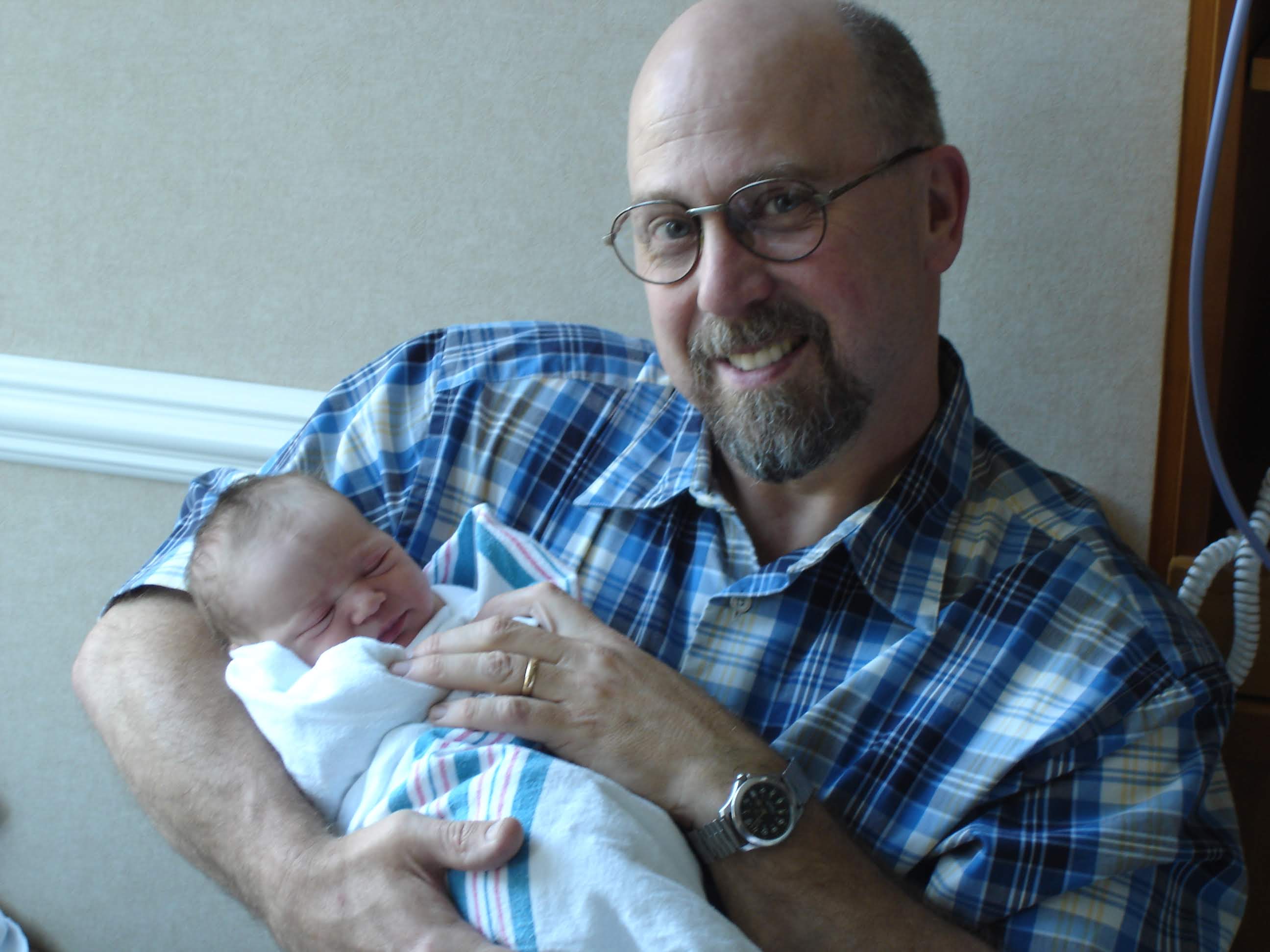
My parents missed the birth, but they were there the next morning, and I remember the photo below being taken during that visit. That is my dad holding her, after all the waiting and the false starts and the trip home and the trip back. The camera metadata puts the picture on April 28 too, although it says afternoon where my memory says morning. I am happy to let the camera and my brain disagree about the hour. They agree about the baby. I think I was away from work for roughly four weeks altogether: about two weeks before she was born and another two after. The surviving emails fit the general shape of that, but I don’t have a timesheet. I also don’t remember anyone at SME delivering a formal “one more absence and you’re fired” speech. There were a lot of phone calls. I could tell they were frustrated. They were also understanding, and somehow they kept me around. I still look back at that and laugh. What a punk.
At some point I spent time in the SME warehouse. I think it might have been right after I came back, but the sequence is fuzzy, so please don’t build a precise employment timeline out of the following confession. I don’t remember my assignment. I don’t remember why I decided to do what I did. I think I was trying to be efficient. What I do remember is taking all the cross braces off some shelving units, discovering that the whole thing was connected across two rows, and watching the shelves collapse like an accordion. Two rows. One blow. I had found a way to turn whatever ordinary warehouse task I had been given into what was probably an absolutely enormous nightmare. I could have gotten myself seriously hurt. It was an extremely dangerous thing to do, and I know that. I also cannot tell this story without laughing at the sheer scale of the fuckup. You hired a new apprentice, he vanished for what felt like a month because his baby was almost being born, and then he returned to demonstrate his innovative new approach to warehouse organization.
I think they sent me home. Surely somebody gave me a talking-to. You would think there would have been a memorable conversation attached to doing something that dangerous and leaving behind a mess that looked like it could take days to untangle. Do I remember one? Nope. Nothing. My brain kept the accordion and discarded the meeting. I think that’s why I got moved back out into the field pretty quickly, but even that is my reconstruction of the sequence, not something I can prove. This is one of the pleasures and irritations of doing these posts: sometimes Gmail can tell me exactly what I wrote on a Tuesday twenty-one years ago, and sometimes I have a vivid image of two collapsing rows of shelving with almost none of the administrative paperwork attached. I remember doing it. I remember how spectacularly wrong it went. The rest is a bunch of “I think,” and that’s how it needs to stay.
I did keep working, and Donal kept being somebody I liked working with. The little projects he trusted me with mattered. I could do them. I could learn. I could be useful without someone hovering over me every second. Then, about a week after I turned twenty-five, my back abruptly changed the subject. I was on a side job with him, covering a grounding wire back up in a shallow trench, when something popped in my lower back. I’ve already told the physical part of that story in “The Spine of the Story,” and the emails help put it in early November 2005. The short version is an injured back, treatment, and eventually the advice that I should find a desk job. I had barely gotten started. In February I was excited to become an electrician. By the end of the year I was trying to figure out what I could do instead. There is something deeply annoying about finally finding a practical direction for your life and having a body part object to the entire fucking premise.
I was scared. I still didn’t have a degree or even a high school diploma. I had a GED, a new family, and now a physical limitation that made the career I had just started look like a bad plan. I knew computers. I knew that was something I could potentially get paid for. But I also knew I had to get in the door, and I didn’t think the GED by itself was going to do that for me. I needed something more. There was unemployment and disability support for a while, and I started taking basic classes at Shoreline Community College. I remember having to go through a course as part of keeping the unemployment money coming, although I don’t remember exactly what the program was. One class I can identify is CIS105, because that is where I mistook a ten-slide assignment for a ten-minute assignment and produced the Star Trek presentation that now has its own post, “Ten Slides, Ten Minutes.” Higher education was going beautifully.
Dwayne supplied the next nudge. He was my best friend, he was also volunteering in Mars Hill’s technology department, and he knew Sam Barrett. He told me they needed help and that I should start showing up. That was pretty much it. No grand recruitment campaign. A friend knew a place that could use somebody, so I went. I hoped it might eventually become a paid job, but mostly I wanted hands-on training. I have always learned better when I can actually do the thing instead of read about it or “practice” it. I like having a purpose to the exercise. My first few weeks were spent installing software on laptops, imaging them from a master copy so they all began in the same fresh state, ready for whichever pastor or deacon needed one. It was easy work that I pretty much already knew how to do. They showed me once and I just went to town. There were computers that needed to be ready, and I could make them ready. That was a useful place to start.
The archive fills in some of how that turned into a job. A December 2006 draft addressed to Sam says I had begun volunteering that May. By late summer, chats with Preston McGee show us sorting out email accounts and figuring out what people needed. In September I was asking about more memory and a better monitor for someone whose computer wasn’t keeping up with her work, and learning who had to approve the purchase. I was dealing with Outlook, calendars, permissions, support tickets, software, and the little problems that accumulate wherever human beings are expected to use computers. Preston was another pair of eyes. Sam was somebody to ask when I needed to understand the process. Seth Faxon was part of the technical world around me. The work spread beyond preparing a batch of laptops because there was other work that needed doing and I was there doing it. I had wanted experience, and pretty soon my days were full of it.
By October, I was staff without the paycheck. I did all the jobs already. I had a desk, a church email address, support tickets, and people who came to me when things didn’t work. I’ve written about that room and that period in “The Job That Wasn’t a Job,” including Julie Hubert inviting me to a staff party and then admitting she hadn’t even realized I wasn’t staff. That pretty well sums it up. I loved the people and the work, and I wanted to be there. I was also waiting for the organization to do the part where the person doing the job gets paid. Those things existed together. In April 2007, Sam asked me to make a case he could use to argue for bringing me on staff: what I’d been asked to do, what I’d accomplished, how many tickets, how many hours, what skills I’d added, and where I still needed to improve. It was roughly ten months of work being gathered into an explanation of why I should be allowed to keep doing the work, only with money.
Sam pushed for me. Zack Hubert worked on getting the hiring approved. In May, Sam told me they were trying to bring me on as an employee with benefits, with June 1 as his hopeful estimate. Then June came, and there was talk of a hiring freeze, and I was still waiting. The chats preserve the anxiety much more clearly than my memory preserves every meeting. I was asking for updates. Sam was frustrated too. By this point I had worked for more than a year without being paid by the church. Everybody around me could see me doing it. Looking back, I’m sure some of them thought I was crazy for not finding a job somewhere else, although that’s what I imagine they thought, not a quote I found in somebody’s email. I had put a lot into this place. I had learned a lot. I was already useful there. I wanted that to count in a way that would help my family live.
On July 25, 2007, the archive finally gets to say it again: “I got a job now, punks.” That line survives in my old Twitter export, carried over from Pownce, because apparently one website was insufficient for announcing my triumph. In a chat with Dustin that same day, I explained that I would start getting paid the following Wednesday, which puts the planned paid start on August 1, with the first paycheck expected on the fifteenth. The announcement and the money weren’t quite the same date. But the meaning, when I try to explain it now, is total validation. I had gone from being fired and unemployed to cleaning buildings, from a janitor’s closet to an oversized lift, from learning a trade to wondering what the hell I could do with an injured back. Friends had pointed me toward openings. Good teachers had given me room to work. I had also taken the braces off an entire shelving system, so let’s not turn this into an inspirational presentation about flawless professional growth. I kept trying to find something I could do, and then I kept doing it. When Mars Hill finally paid me, it felt like they were acknowledging the person who had already been sitting there doing the job all along. I was made whole, and shown that my effort was worth it.


Leave a Reply