The random date generator landed on May 26, 2020, and my first reaction was, “Ew. I don’t like that date.” We were a couple of months into the pandemic, which did not immediately strike me as a period I was eager to revisit. But apparently, while I was bored at home, I had decided to go looking for people who had been dead for a very long time. As one does.
That morning, I wrote to a genealogist I had corresponded with years earlier: “This morning I got back on the trail (probably because I’m bored at home).” The trail was the Wygle family, and the person was Cheryl. Eleven or twelve years after my first burst of research, I was back with the same questions. Where did we come from? Who were these people? And why was it so difficult to get past this one particular guy?
I’ve always been curious about the name. Growing up, there weren’t exactly Wygles on every corner. There were plenty of people willing to call me “Wiggle,” but that was not especially helpful genealogical research. I never met my paternal grandfather, and the Wygles I knew were a small group: my dad, my sister, my aunt. I wanted to know what came before us. Not just names and dates, but where people lived, what they did, and how this particular collection of letters wound up attached to me.
The emails took us back to November 2008, when I was about a week into researching with my dad and was very excited about Geni, Google, and the possibility that other people had already figured some of this out. Other people certainly had been working on it. Cheryl shared a substantial research document, Loretta “L. J.” Kalmar brought decades of work, and Jack Wygle and Dan Holcombe helped put people and branches into place. There is something lovely about reading those exchanges now. I went looking for dead relatives and found living ones.
Cheryl’s research document began with a heading that deserves some kind of award for honesty: “Mr. X Wigle.” Seventy-one pages of research, questions, records, and possible connections, and right there at the beginning: we do not know who this man is. That is considerably more useful than a family tree confidently introducing you to someone’s eighteenth-century grandfather because the last names look close enough.
The working line back from me runs through Greg, Donald Ray, Carl Leonard, Charles Johan, Uriah Morgan, Jacob, and John Wigle. John was born around 1795–1797 and was associated with Hardy County, in what was then Virginia. He married Sarah Patrick. From John forward, the family becomes much easier to follow. Before John, the trail gets complicated. Wigle, Wygle, Weigel, Wiegel: the spelling moves around, and a familiar-looking name is an invitation to investigate, not permission to attach a person.
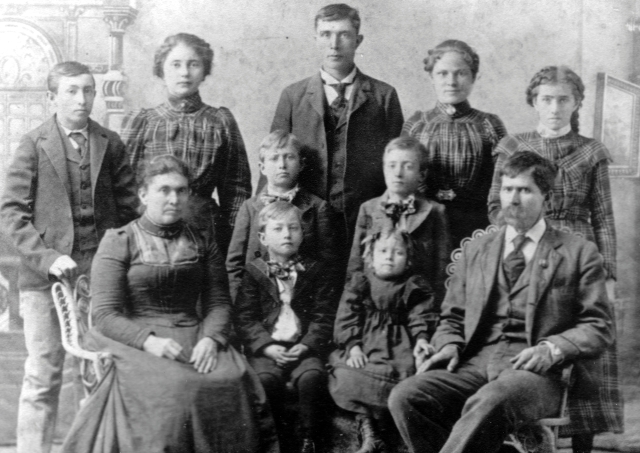
We found photos along the way, too. This is the Uriah Morgan Wygle family portrait I want to keep with this story. The Geni page labels it Kansas, 1898, and credits the album to Daniel Lee Holcombe. Uriah is seated on the right, and Inger Bertha is seated on the left. Albert Christian stands at the back center, with his wife Essie Pearl immediately to his right. After all those names in boxes, here are people. Actual faces, clothes, chairs, and an entire family holding still long enough for us to look at them more than a century later.
The 2020 emails also led to a transcription Cheryl sent of a letter John Wigle wrote on June 20, 1869. One sentence stopped me: “I hardly know whether I am writing to the dead or the living.” He was writing to a nephew, with family scattered and news uncertain. It didn’t tell us who his parents were. It did something different. For a moment, John stopped being the person blocking the next branch of the tree and became a person trying to find out what had happened to his family.
On the original random date, I was also trying to locate The History of Hardy County, 1786–1986. I emailed Daniel Hyde about an old lead, learned that the person I had hoped to contact had died, and got a suggestion to try interlibrary loan. A few days later, I was talking about going to the Seattle library “once it opens back up.” There’s 2020, preserved in one small sentence. My answer to the setback was, “I’ll keep plugging away.” Apparently I meant it.
There was progress after that, and I don’t want to flatten everyone’s work into “we never found anything.” A professional report Cheryl shared in 2022 made a substantially stronger case for Jacob Wigle as Robert’s father and supported a connection to John. Among its evidence were tax records referring to the widow of Jacob and sons, followed by Robert and John in adjacent entries with continuity in the household and property. That is a real argument built from records. It gives us more than an empty box with a guessed name. It still doesn’t provide a secure bridge to a German immigrant, and we don’t have all of the report’s underlying research materials in this packet.
We also briefly encountered an extremely confident account connecting the family to the Whiskey Rebellion and a German immigrant patriarch. It was very exciting, right up until the part where it needed evidence. I would enjoy having a whiskey rebel in the family as much as the next person, but we are not building a bridge out of matching surnames and enthusiasm. The paternal Wygle story still has an open end. The researchers before me knew it, and I can leave it open, too.
But while all this was happening, I remembered that I had also worked on my mother’s family. I knew my grandma Dorothy, and I knew my great-grandmother was Bertha. I remembered getting to Germany on that side. So before we packed away the maps and old handwriting, I wanted to back up and follow the mothers.
That changes the shape of a family tree pretty quickly. Dorothy’s maiden name was Stoll, but following her mother doesn’t mean following Stolls forever. The route we were reconstructing went from me through my mom, Grandma Dorothy Mae Stoll, Bertha Wissel or Wessell, Gertraud Christine Wiegel, and Catharine Holdinghausen. Each marriage changes the name we’re looking for. The line of women is still there; the labels keep changing.
And yes. Wiegel.
I couldn’t get the Wygles to Germany, but here were Wiegels in Germany on the other side of my family. This does not establish that the two families are connected. I cannot emphasize that enough, mostly because my own brain would very much like to put on a party hat and skip that sentence. They are separate trails. The coincidence is still excellent material for a place called the Wygle Wide Web.
Bertha’s German baptism index gives her birth as December 9, 1885, and baptism as January 10, 1886, in Freudenberg. Her parents are listed as Hermann Wissel and Christine Wiegl. That is an indexed transcription, not an original page we independently read, and the spelling deserves to travel with it. But it gave us something specific to follow.
Christine’s 1912 Missouri death certificate was both helpful and unhelpful in the way old records sometimes manage simultaneously. It gave her birth date as January 24, 1864, in Germany. Her father’s name was “Unknown Wigel.” Unknown is a really odd first name for a German kid, but I suppose we should consider the possibility that the person supplying the information simply didn’t know.
Fortunately, “unknown to the person filling out this form in Missouri” does not necessarily mean “unknowable forever.” A German baptism index for Gertraud Christine Wiegel gives the same birth date, January 24, 1864, with a baptism on January 31 in Siegen. It names her parents as Johannes Heinrich Wiegel and Catharine Holdinghausen. Alongside the marriage and family records we were comparing, that was a much better lead than Mr. Unknown.
This is where the project acquired a paid subscription to German church records. I bought a month of Archion access, which felt like a very reasonable response to being personally challenged by nineteenth-century handwriting. Somewhere in there, this stopped being a quick look at an old email and became a small expedition.
For the Wiegel detour, we worked backward toward an 1853 marriage record in Siegen. The groom, Henrich Wiegel, was recorded as a Bergmann, a miner, and was about thirty-two. The bride was Catharine Holdinghausen, about twenty-five. The age, places, and partially legible parental information pointed us toward an 1821 baptism in Rödgen for a Henrich Wiegel from Niederdielfen. The father there was Johannes Henrich Wiegel, a Steiger, or mining foreman. The mother was Anna Margarethe; our working reading of her maiden name was Reitz.
That is the connection we spent the most time trying to make solid: was the man marrying in 1853 the child baptized in 1821? The age fits. The locality and the parental names we could make out fit. Other family records helped us compare the household. But some of the ink is difficult, and some of the handwriting remains beyond our confidence. Our conclusion is a strongly supported working identification, with room for someone better at reading these records to confirm or correct it. For this post, I’m comfortable exploring the story that connection suggests, as long as I don’t quietly turn “very promising” into “proved.”
The detail that made the 1821 record stick with me was an annotation: “Nach des Vaters Tod geboren.” Born after the father’s death. If we have the right Henrich, his father had died before he was born. We don’t know from that note how the father died, and a mining occupation is not evidence of a mining accident. But the line itself is enough. A baby born after his father’s death, recorded in a church book, waiting two hundred years for a distant person with a similar last name to squint at it on a screen.
We also found a possible 1811 marriage for the older Johannes Henrich Wiegel and Anna Margarethe Reitz. It is another lead, not an excuse to race through several more generations. The further we went, the more I appreciated the people who write down exactly what they can read and leave the rest alone. “I think this says…” is doing important work in a project like this.
For anyone who wants to pick up that thread, the 1853 marriage is in Siegen’s 1844–1862 marriage register, image 105, entry 28. The 1821 baptism is in Rödgen’s 1820–1846 baptism register, image 43, printed page 12, entry 24. The possible 1811 parental marriage is in Rödgen’s 1810–1819 marriage register, image 24. Archion requires access to view the scans, but those locations should make the trail easier to resume. If old German handwriting is your idea of a good afternoon, I have a hobby for you.
Then we returned to the mothers. Christine’s mother was Catharine Holdinghausen, and we wanted to see whether we could take that particular line another step. An 1828 baptism looked promising: a Catharine with a father read as Johann Heinrich Holdinghausen, a tailor, and a mother whose given names appear to be Maria or Marie Elisabeth. The mother’s surname may be Lück. That last part is particularly tentative; the writing and the binding do not appear to have been arranged for my convenience.
The candidate’s age fits the bride in 1853, and another baptism helped us recognize the possible parents’ household. What we still lack is a clean, independent link establishing that this child is our Catharine. We even encountered another plausible Catharine who turned out to belong to a different marriage. A good reminder that finding the right name is the beginning of the question. It is not the answer.
So Maria Elisabeth, possibly née Lück, gets a pencil mark. She does not get promoted to confirmed ancestor just because I would like to keep going. The candidate baptism is in the Siegen register, image 134, printed page 129, entry 16. That is where I’m leaving a bookmark for the next person, or for me after I’ve recovered from this round of squinting.
We ended up with three paths: the paternal Wygles and their still-unfinished parentage problem; the mothers through Dorothy, Bertha, Christine, and Catharine; and the Wiegel detour into German mining families, with one important connection still wearing its qualifications. Some of this comes from original records we could inspect, some from indexes, some from family trees and correspondence, and some from our interpretation of very old handwriting. Those are different kinds of evidence. I want the story, but I want the seams to remain visible.
I also don’t want to lose sight of how many people made any of this possible. Cheryl, Loretta, Jack, Dan, the professional researchers, the people who saved photographs and transcribed letters, the people who indexed records: I’m arriving late to a very long conversation. The old emails and privately shared research are part of my family archive; the public record links above are there so this post can leave a useful trail of its own.
The random date gave me a day when I was bored at home and decided to try again. Following it brought me back to the same stubborn Wygle question, but it also brought me new relatives, an old family portrait, a man wondering whether his nephew was still alive, and a German record of a child born after his father had died. I didn’t get every answer. I did get a much larger sense of the people behind the names.
And I got Wiegels in Germany. Different trail, carefully placed asterisks, excellent spelling coincidence. I’ll take it.
Apparently, I’m still plugging away.


Leave a Reply