Random Date Archeology usually starts with a date and a rule that I am not allowed to make it prettier than it is. Pick a day, look at the wreckage, see what survived. Some days produce almost nothing. Some produce a tiny stupid thing that turns out to be a trap door into an entire era of my life. For #20 I wanted something substantial, though, and the random machine handed me Wednesday, March 8, 2017, which at first looked like one of those ordinary Wednesdays that only becomes absurd once you put all the pieces back on the same table. That morning I was helping preserve old episodes of The Swing Years and Beyond. Around lunchtime I was teaching television production at iDEA. In the afternoon I was supposed to collect reimbursement money and a case of beer from a teachers’ union president because I had recently livestreamed a town hall by throwing a network cable out a third-floor window. And while all of that was happening, I was also negotiating the sale of three Blackmagic Design 4K Studio Cameras that I badly wanted out of my life. By 9:49 that night eBay told me they had finally sold. Forty-three minutes later the buyer told me PayPal would not take his money. That turns out to be a pretty good little miniature of this entire period of my life: I was doing five different interesting things at once, solving other people’s problems, building systems, teaching kids, preserving weird cultural artifacts, and somewhere underneath all of it there was a financial fire that I had become very good at walking around while carrying equipment.
The radio archive is worth mentioning because it is such an aggressively me thing to have been doing on the same day. A few days earlier I had seen Amanda Wilde mention old Swing Years recordings and wound up in contact with Jan Byron, who had something like 120 episodes sitting on a drive, around fifty-one gigabytes of them, most from 2014 and 2015 with a handful from other years. She had recorded the stream with Total Recorder because she loved the show and especially loved the little pieces of Amanda’s voice that existed in the live broadcasts but sometimes disappeared from the official archive versions. I had recorded a France tribute episode and the final show myself, and I had chopped that final broadcast into four pieces so I could keep it on my phone and iPad, which is a sentence that tells you roughly how my brain works. Jan wanted the files somewhere fans could actually get to them. I had a terabyte of Google Drive and a terabyte of Dropbox, so naturally I was volunteering storage, creating a Dropbox file request, offering to mail a drive if uploading fifty-one gigabytes became ridiculous, and generally behaving like the Wygle Wide Web already existed even though I would not give the instinct a name for another nine years. On March 8 at 10:22 in the morning Jan asked me to remove her name from some filenames. At 10:23 I replied, “Done! Thank you so much. Let me know if there’s anything else I can do.” By lunch she was sorting which recordings came from the live stream, which came from the archive, and which had Jack or Kate hosting, because she thought that once word got out other fans would come forward. She was right about the basic human impulse, anyway. People keep things. They forget they kept them. Then another person comes along years later and asks a question, and suddenly a hard drive becomes history.
At 12:15 I was at iDEA teaching, which was another strange little branch my life had grown by then. I was there until 1:45, and almost immediately afterward I had another errand that makes this day sound made up. Nathan Bowling, who had been Washington’s Teacher of the Year in 2016 and taught at Lincoln High School, had introduced me to Angel Morton because they wanted to livestream an education town hall. Nate described me to her as the guy who ran Bootstrapper Studios and a “master of multimedia,” which is very flattering language for the man who would shortly propose solving their internet problem by dropping a cable out a window. The event was at the IBEW building on South 36th in Tacoma. We needed network access in the meeting hall. The usable connection was three floors up. On February 22 I wrote, “Alright. We have a plan that involves throwing a network cable out a window, down 3 floors, and then into the meeting hall. It’s going to work.” And it did. I also tied into the room audio and tried to cover that job at the same time because apparently the staffing plan was Adam. A week later Angel emailed with the subject line “Beer money” to say they had a check to reimburse me for the cable and a case of beer to thank me for everything I had done. On March 8 I told her I could swing by around two. She replied that morning, “Great! see you this afternoon.” So there is a decent chance that within fifteen minutes of finishing a class full of television-production students, I was driving across Tacoma to collect cable money and beer for an improvised livestream in which Ethernet had literally descended from the heavens.
And then there were the cameras. The file in my Google Drive is actually called Blackmagic Dream World, which is such an exquisitely ominous title in hindsight that I do not think I could improve it if I were writing fiction. I created it in April 2015 as a shopping list for the broadcast system I wanted Bootstrapper to become: an ATEM 2 M/E switcher, three Blackmagic Studio Camera 4Ks, two Micro Studio Cameras, a talkback converter, five HyperDeck Shuttles, seven Sennheiser headsets, fiber cable, lenses. Total dream-world price: $21,940. It was beautiful on a spreadsheet. Everything spoke the same technical language. The cameras could live on fiber, talkback and tally could be integrated, camera control could come back from the switcher, and the whole system felt like a way to move us from a collection of adapted production gear into something that behaved like a little television truck. We did not buy the whole dream exactly as that spreadsheet imagined it, but in the spring of 2016 we did make the big leap and buy three Studio Camera 4Ks. The surviving equipment order checklist puts those three bodies at $7,092.79, plus camera controls, six ATEM camera converters, fiber adapters, long fiber spools and a Studio Converter. This was not me casually buying three toys because they looked neat. I was building an ecosystem around them.
I also did not do enough homework, and I want to be very clear about that because memory has a way of slowly rewriting a bad decision into something that happened to you. I made the decision. I remember Blackmagic’s marketing making the Studio Cameras look exactly like the kind of thing we needed, including imagery that I remember as a camera operator working a football game, and I came away with the idea that these would be great for night sports. Maybe every individual sentence in the marketing was technically defensible. Maybe I supplied some of the optimism myself. What I know now is that I did not do the level of due diligence I should have done before spending thousands of dollars and reorganizing a production system around three cameras. The problem was not that the cameras were garbage. They were not. Indoors, with good light, they worked great. We used them for other events and they did what they were supposed to do. Even the surviving soccer highlights I have gone back and watched during this excavation are not some murky disaster. I had remembered them as worse than they actually were. The fields were often just dark, especially Starfire, and a camera can only photograph the photons that actually show up for work. The deeper problem was that Bootstrapper was almost never a studio-production company. We were dragging equipment into stadiums, gyms, event spaces, temporary control rooms and whatever strange corner someone had given us that day. We needed cameras designed to live in that world.
This excavation even corrected one of my favorite examples of the problem. In my head, for years, I had attached the Blackmagic cameras to the Red Card Wedding, the completely deranged June 2015 Open Cup match at Starfire where Seattle finished with seven players, Clint Dempsey tore up the referee’s notebook, Obafemi Martins was injured after the substitutions were gone, and the whole thing became one of those games Sounders people can identify from three words. I remembered our footage being so dark that it was difficult to see what was happening, and when we started talking about the Studio Cameras I immediately said, basically, there, that was the night. Except the Red Card Wedding happened on June 16, 2015. We did not buy these cameras until the following spring. I had fused two true things into one false memory: Starfire really was dark that night, and the Studio Cameras really were not the best choice for our outdoor sports work. They just were not the cameras we used for that game. I went back and watched some of the old highlight videos and the footage is honestly not even that bad. The field was just fucking dark. This is one of the reasons I keep doing Random Date Archeology. Memory does not usually lie in some grand theatrical way. It edits. It moves a shot from one scene into another because the emotional continuity works better there.
Before the Studio Cameras we had been shooting on Panasonic AF-100s, which were lovely little MFT cameras for a lot of things and another example of us making gear do jobs it had not really been born to do. Camera operators would be following a soccer match and, when they needed focus, physically reach around the body of the camera to get to the lens. We got used to it because crews get used to anything if you give them enough games. Then the Blackmagics came along and solved a bunch of system-level problems, but over that season I slowly had to admit that the cameras themselves were still a compromise. They worked well enough that it took longer than I think it should have to say it out loud. That matters too. The most dangerous equipment mistake is not always the thing that immediately explodes. Sometimes it is the thing that works at eighty percent, because eighty percent lets you keep defending the purchase. We made it through the year. Meanwhile I had started looking for used ENG cameras, the big ugly purpose-built television things I probably should have been shopping for in the first place.
Then we lucked out. Another production company in the area were unloading three JVC GY-HM750s. I do not know anymore how the deal made its way in front of my face. There is a decent chance the answer lived in my old Bootstrapper Studios email account, which I no longer have access to, because my personal Gmail is weirdly silent about the actual purchase. What I remember is that we had been watching for decent used ENG cameras for a while, and when these appeared I knew what they were and what they would solve. We had tested enough and researched enough this time that I was not gambling on the category. The package was also fantastic. It was not three naked camera bodies that would then require another month of spending. They came with lenses, proper viewfinders, a nice rolling case that held all three of them, and, crucially, focus and zoom control extensions that mounted to the handles of our tripods. That sounds like a tiny technical detail until you have spent ninety minutes following a soccer ball while trying to reach around a camera body every time focus shifts. Suddenly our operators could keep their hands where their hands belonged. They could pan, zoom and focus from the handles. These were older cameras than some of the gear they replaced, and they felt like the future anyway.
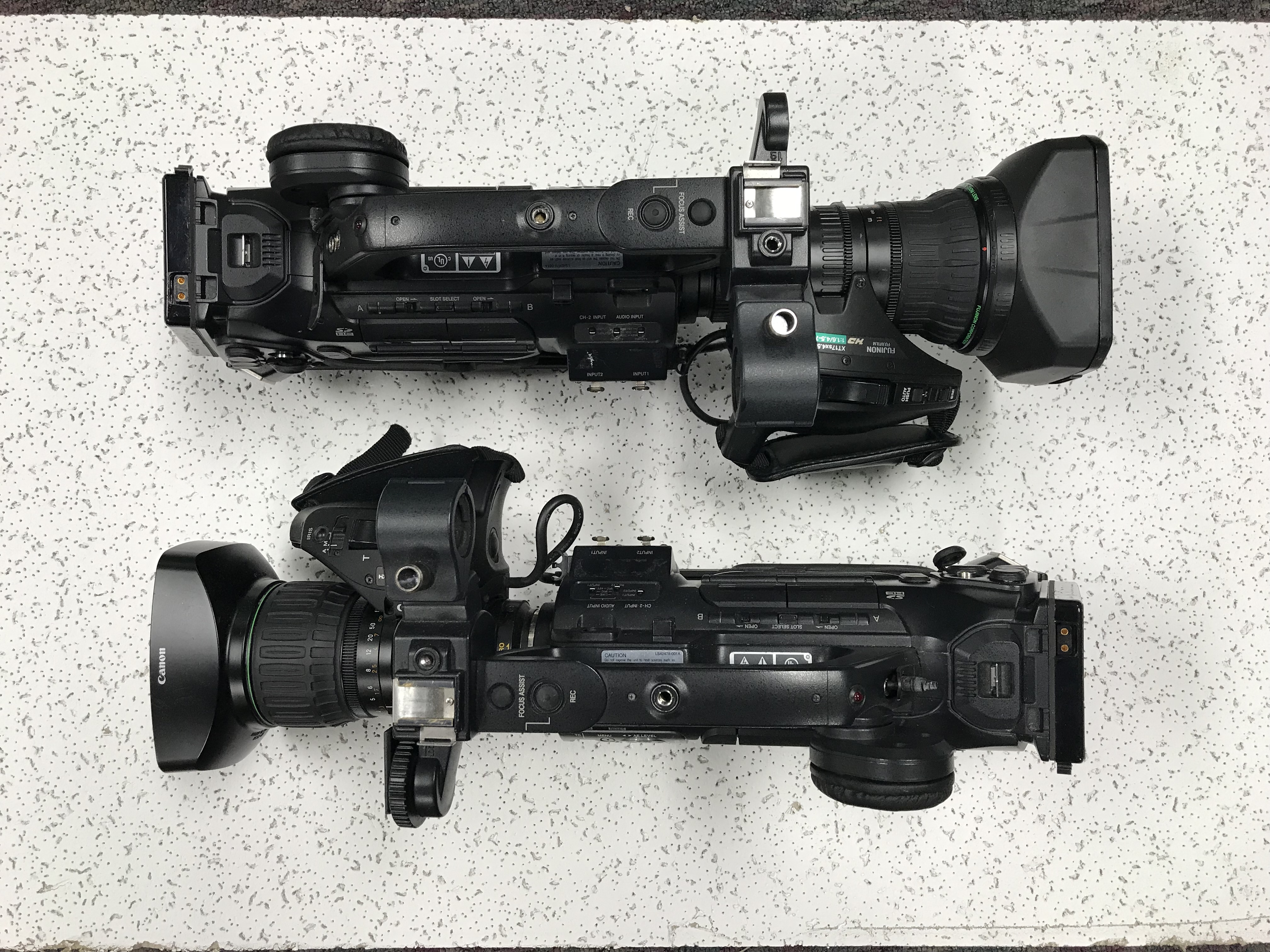
The difference was immediate. Our camera operators felt spoiled. These were proper broadcast cameras, with controls in places that assumed a human being would be standing behind the thing for hours trying to catch action as it happened. They were light-years ahead of anything else we had used for live sports, even though technologically they were already old. They just worked better for the production we were actually doing. The camera body sat right. The lens sat right. The viewfinder sat right. The controls sat under the operator’s fingers instead of hiding around the side of a compact camera body. There is a whole philosophy of tools hiding inside that. Newer is not necessarily better. Higher resolution is not necessarily better. A beautiful spec sheet is not necessarily better. The best tool is the one whose designers correctly guessed what your hands, your eyes and your crew will need to do at 8:43pm when somebody is sprinting down the touchline and no one gets a second take. Buying those JVCs may have been the best equipment decision I ever made for Bootstrapper. We used all three as our main soccer cameras for the rest of the company’s life.
There was one fairly important complication: Bootstrapper did not have eight grand sitting around waiting for this revelation. I bought the JVCs on my personal credit card while we still owned the Blackmagic cameras. I remember the package being somewhere around $8,000 to $8,500. It felt necessary rather than reckless because we had already been looking for the right cameras and this was the right package, but that does not change the fact that for a while I had both three-camera systems sitting there at the same time and my personal credit was bridging the transition. We put the Studio Cameras on eBay and Craigslist. The inbox from early 2017 is a parade of hope, lowball offers and nonsense. Somebody offered $1,000. Somebody offered $5,000. One buyer got flagged as suspicious. Another “bought” them and then vanished. I kept relisting them. By March I was countering around $8,000 while buyers kept trying to drag the number down. One persistent buyer got to $7,300. I wanted $7,500. On March 8 he wrote to ask whether I still wanted the $7,500 because he had $7,300. That evening eBay finally sent the magic email: “Your eBay item sold!” At 10:32 PM the buyer wrote that he had tried to send the $7,300 plus shipping through PayPal and got a payment error. So the cameras were sold, except they were not sold, which is an extremely 2017 Bootstrapper Studios sentence.
The first league game that seems to line up with the JVCs is S2’s March 26 home opener against Sacramento Republic at Starfire. I cannot prove from the surviving production paperwork that this was literally their first Bootstrapper soccer broadcast, and there could have been a preseason test or some undocumented event before it, but the timing fits my memory that we got the cameras in January or February, and S2 started before Reign did that year. What I can say without any qualification is that once they arrived, we never went back. The JVCs became the soccer cameras. The Blackmagics became a problem to sell. That alone turns March 8 into a funny hinge point. I was already holding the solution in one hand while still trying to convert the old mistake back into cash with the other.
Then, while working on this story, I went back and looked at Random Date Archeology #14, “The $81,096 Mistake”, and the camera timeline suddenly got a lot darker and a lot funnier. Number fourteen is built around April 5, 2017, less than a month after the random date in this story. That was the day Northwest Justice Project was helping Heidi and me prepare an answer to the lawsuit over the $81,096.18 HUD lien that had somehow survived the sale of our Lynnwood house. We had been served in March. On March 24, sixteen days after this camera sale failed, I tweeted, “I’ll tell y’all, bankruptcy causes physical pain.” By April we were filling out Chapter 7 paperwork. On April 11 I sent our lawyer a debt list that included a BECU line of credit for about $12,500 and a BECU credit card for about $10,500. When I reread that paragraph while working on this post I stopped, because I had just spent the previous hour telling this story about the roughly eight-thousand-dollar JVC purchase that I put on my personal card. I asked myself the obvious question: was that the BECU credit card? Yep. It sure fucking was.
Which means that one of the best business purchases I ever made happened at almost exactly the same moment my personal financial life was collapsing into bankruptcy. There is probably a responsible grown-up way to phrase that. I prefer the version I blurted out when we made the connection: I kind of got the cameras for free. Eight thousand dollars worth of cameras for the low, low cost of a bankruptcy. Obviously that is not how bankruptcy works emotionally, morally, legally or mathematically. Number fourteen is several thousand words documenting just how expensive that “free” reset actually was. We had an $81,000 title-company nightmare hanging over us. We were terrified we might lose the Tacoma house we had just bought. I was physically carrying stress I did not know how to name yet. We had years of debt, layoffs, underemployment, Bootstrapper winters, medical bills and survival decisions stacked behind us. Chapter 7 wrecked our credit and required attorneys and court and humiliation and an awful lot of paperwork. It also discharged a pile of unsecured debt, including the card I had just used to buy the cameras that would carry Bootstrapper through the rest of its soccer work. History has a sense of humor and sometimes it is kind of an asshole.
The symmetry gets even stranger. We officially filed bankruptcy on June 1, 2017. The Blackmagic cameras, after months of listings, fake buyers, unpaid-item cases, suspicious accounts and increasingly depressing offers, finally sold for real on June 6 for $5,000. I printed the shipping label two days later. So five days after filing Chapter 7, the expensive three-camera mistake that I had been trying to unwind since the beginning of the year finally left the building, while the JVCs I had bought on the credit card that was now tangled into that bankruptcy stayed behind and kept working. I could not possibly have seen the poetry in that at the time. At the time I was almost certainly just relieved somebody had finally paid for the goddamn cameras. But from here, with the dates stacked together, it is hard not to see March through June 2017 as one giant equipment swap happening inside one giant financial reset. Wrong cameras out. Right cameras in. Old debt out. New production system stays. Try not to think too hard about how any of that was paid for.
That is also why I cannot tell the Bootstrapper story as either a wonderful thing I miss or a terrible thing I escaped. Both versions are true and neither is enough. I loved that work. I loved the weird problem-solving, the live productions, the people, the feeling when a system came together and a crew started behaving like one organism. I loved the soccer years. I loved being the guy who could look at a three-story building and say, yes, actually, I think Ethernet out the window will work. I loved finding old broadcast cameras that everybody else considered yesterday’s technology and discovering that they were exactly what our camera operators needed. I still miss those days. I also never want them back. Bootstrapper almost destroyed me. I was very good at functioning inside stress, which for a long time I mistook for not being stressed. I could have a genuinely great time doing the work while my jaw, my bank account, my sleep, my marriage or some other part of my body was quietly keeping a different set of books. The fact that I remember the JVCs with enormous affection does not erase the context in which I bought them. The context is part of why they matter.
After Bootstrapper finally shuttered, I sold two of the JVCs on eBay. I still have the third one. I have periodically looked at it and wondered what exactly I am supposed to do with it now. It is deeply obsolete by contemporary production standards. Fewer and fewer places even use that style of big shoulder-mounted ENG camera anymore, and there are smaller cameras today that can make images those JVC engineers could only have dreamed about. But that almost makes me want to keep it more. It is not useful to me in the ordinary sense. It is useful in the way an artifact is useful. It is one-third of the package that fixed a problem I had created. It is the camera system that made my operators feel spoiled. It is a tool that stayed for the rest of the company after the shiny new Studio Cameras were boxed up and shipped away. It is tangled into the bankruptcy story, the soccer story, the BECU card, the lean years, the good years, and all the strange ways I learned things by doing them expensively.
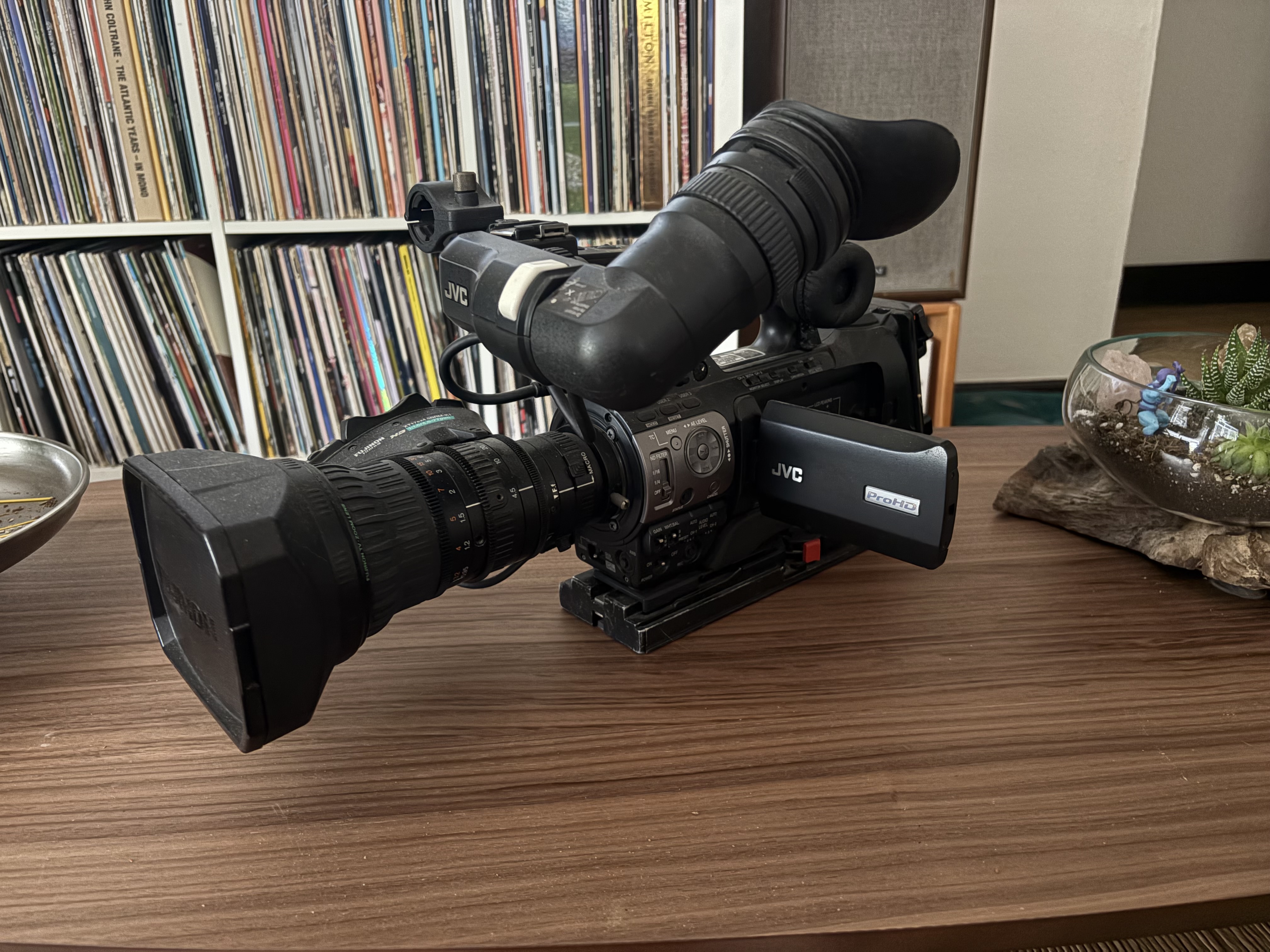
Here it is, sitting on my table, in front of my records, looking enormous and prehistoric and completely at home. Two of its siblings eventually went back out into the world. This one did not. For a while I thought that meant I still needed to decide what to do with it, as though every object is supposed to justify the square footage it occupies by having a current job. I think I have decided. I am keeping the damn camera. Someday somebody will probably look at it and ask why I still own this ridiculous old broadcast thing, and I will get to say that it was one of the best purchases I ever made, that it cost me about eight thousand dollars, that in another extremely stupid sense it cost me nothing at all, and that the explanation involves soccer, a bad equipment decision, an $81,096 lien, a BECU credit card, Chapter 7 bankruptcy, a case of beer, fifty-one gigabytes of old radio, and a network cable hanging out a third-floor window. Which, now that I think about it, is probably as good a description of Bootstrapper Studios as anything I could write.


Leave a Reply