My friend Dwayne sent me a text.
“I made a prompt to simulate an old bbs game I used to play. Wanna try it?”
Dwayne had been remembering Legend of the Red Dragon, an old BBS door game from his youth, and had built a simulation of it in Claude.
He sent me the whole thing.
And because apparently this is how my brain works, my immediate thought was:
I wonder if I can just dump all of these instructions into ChatGPT.
So I did.
Not rewritten. Not converted into some special ChatGPT format. I just loaded the instructions whole and tried to play it.
And it fucking worked.
Suddenly I was playing Dwayne’s LORD inside ChatGPT.
It wasn’t just ChatGPT describing an old computer game to me. There was a world there. Menus. Choices. Characters. Atmosphere. Things happened because of things I’d done earlier. It remembered the game state.
At some point I realized ChatGPT wasn’t only running Dwayne’s instructions. It understood the structure underneath them well enough to keep the thing alive.
And that is when I had the dangerous thought.
Wait.
I have data.
A lot of data.
Photos. Emails. Tweets. Blogs. Text messages. Music. Videos. Audio recordings. Family stories. Old websites. Chat logs. Documents. Twenty-plus years of internet debris and forty-five years of life that I have been slowly turning into the Wygle Wide Web.
What if, instead of asking somebody to search that database…
I built a place they could enter?
That was the beginning of THOR: The Hall of Remembering.
Dwayne’s LORD remains Dwayne’s creation. In fact, preserving that boundary became one of the first rules of THOR. LORD is an artifact someone else made and shared with me.
THOR is the idea it accidentally gave me.
Welcome to THOR
THOR is The Hall of Remembering.
It is an original Wygle Wide Web game/world/interactive archive/thing-I-have-clearly-lost-control-of.
You connect to it like an old BBS. There are modem noises. Monospaced text. Single-letter commands. You type your first name when you arrive, and then you enter a strange little kingdom where forgotten things aren’t lost.
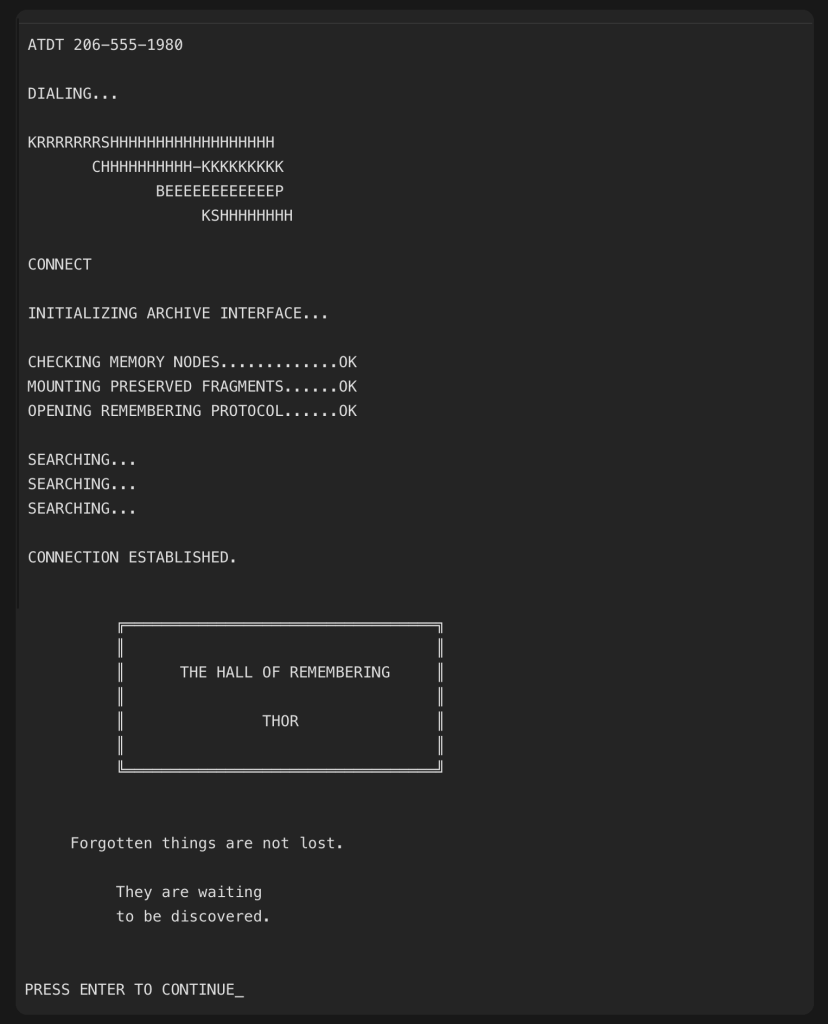
They’re waiting to be discovered.
The underlying archive is real.
That’s the rule that makes the whole thing work.
A photograph in THOR has to correspond to an actual photograph. A story has to come from something I remember or something preserved in the archive. A relationship has to be supported by the material we actually have.
If THOR doesn’t know something, it is allowed to say:
The realm does not yet know this memory.
It is not allowed to make shit up just because making shit up would improve the plot.
Which is an admittedly strange design constraint for a fantasy game.
But that’s the point.
The fantasy isn’t replacing the archive.
The fantasy is how you explore it.
The Hall
The Hall of Remembering is enormous and somewhat badly behaved.
There are rooms dedicated to different kinds of memory. There are endless storage corridors called the Archive Depths. There is a Portrait Registry where people from my life slowly become discoverable. There is a Listening Room that looks like an impossibly large record store, where songs can lead into the memories attached to them.
There is a Lantern Keeper who tends the photographic archive.
There is a mysterious Archive Shack sitting outside the Hall, full of the things that survived more or less by accident.
There is also a Theater.
We will talk about the Theater another time.
Probably after I have emotionally prepared everyone involved.
The Hall itself is constantly changing. Rooms move. Hallways get shorter. Things that happened twenty years apart may suddenly wind up beside each other because that is how memory actually works.
Chronology still matters. History doesn’t change.
But chronological distance and memory distance are different things.
Something from 1998 can suddenly feel like it happened yesterday. Something from last Tuesday can feel like it belongs to another geological era.
History determines when a room was built. Memory determines how you reach it.
There Are Goblins
Obviously.
The Archive Goblins appeared somewhere during development and immediately became indispensable.
They are small green archive workers who spend their lives carrying boxes, filing things, repairing whatever the Hall moved overnight, getting stuck in drawers, gossiping with each other, and generally being extremely competent at their jobs while looking like they absolutely are not.
They also carry pieces of my old Twitter archive.
This has become one of my favorite mechanics in the entire game.
When you encounter an Archive Goblin, you may be able to talk to it.
Or you may be able to BONK it.
The bonking weapon is soft. A pillow. A nested pair of socks. Something along those lines.
This is not combat.
Apparently bonking is simply part of Goblin culture.
If you talk to a Goblin, it may tell you a little story connected to something in the archive. If you bonk it, it may surrender an actual old tweet.
We currently have 2,064 approved tweets waiting for this purpose.
So one of the largest datasets I have ever painstakingly cleaned exists because someday I want my children to log into an imaginary 1990s computer system and hit a goblin with a sock so it will show them something stupid I tweeted in 2008.
I feel very good about this decision.
The Ancient Printer
Photographs created another problem.
A BBS is text.
My archive contains thousands and thousands and thousands of photographs.
ASCII art was one possibility, but it never quite felt right. Eventually we invented the Citizen 120-D, an ancient dot-matrix archive printer.
When you discover certain visual memories, the machine wakes up and produces a continuous-form printout: a strange dot-matrix interpretation of the original photograph, along with archival information.
The printout isn’t the photograph.
It’s the machine’s memory of the photograph.
Right now this is actually the part of THOR I’m building. I have 75 photographic artifacts prepared for the Lantern Keeper system, and I’m working on the renderer that will turn them into consistent Citizen 120-D archive prints.
This is one of those moments where the ridiculous imaginary thing and the extremely tedious database work underneath it become the same project.
Which is basically THOR in miniature.
This Got Bigger Than I Expected
THOR began with a text from Dwayne and a dumb little experiment: can ChatGPT run this thing he made?
Now it has characters, locations, laws, reward systems, thousands of source artifacts, a growing photographic pipeline, individualized paths for people the archive recognizes, and enough internal documentation that I occasionally need the fictional archivist to explain the archive I invented to organize my archive.
That archivist is called The Curator.
He has a backlog.
Naturally.
But the thing that keeps making me want to build this isn’t really the game mechanics.
It’s the idea underneath them.
I’ve spent months recovering pieces of my life, and the thing I keep discovering is that the interesting part isn’t the individual artifact.
A photograph is never only a photograph.
A song is never only a song.
A tweet is never only a tweet.
You find a photograph and suddenly you’re talking about the camera that took it, the person standing beside you, the apartment you lived in, the song you were listening to, the relationship that was beginning, the relationship that was ending, another photograph taken six years later, and some completely stupid joke that somehow survived in an email inbox.
The memory isn’t the object.
It’s the web around it.
That’s what THOR is trying to make explorable.
Not a biography.
Not a museum.
Not a folder full of files labeled ADAM — IMPORTANT — FINAL FINAL 2.
A place.
A ridiculous, enormous, occasionally malfunctioning place where someone can wander around, open a drawer, follow a strange hallway, bother an archivist, listen to a record, bonk a goblin with a sock—
—and find me.
Welcome, traveler, to The Hall of Remembering.
 Wygle Wide Web
Leave a comment